US Census Bureau Bans Noise Infusion in Statistical Products
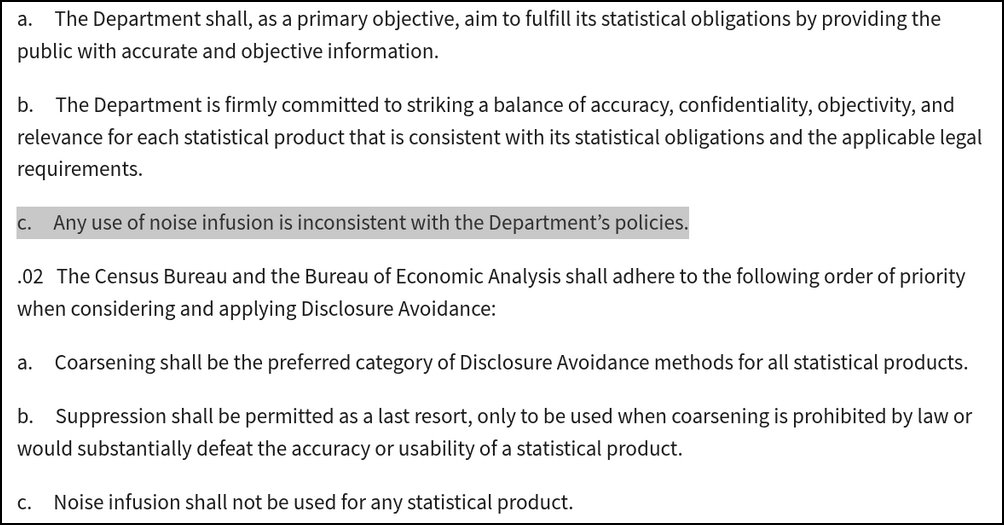
The U.S. Department of Commerce just decided that "noise infusion" is out. Last week, they issued an order banning the practice for all statistical products coming out of the Census Bureau and the Bureau of Economic Analysis. For anyone who cares about how we protect sensitive data, this is a weird move.
The goal of disclosure avoidance is simple. You have a secret dataset full of private information, and you want to publish a set of numbers based on that data without accidentally doxxing the people in it. For years, the gold standard has been adding mathematical noise to the results. It's a way to keep the statistics useful while ensuring no one can reverse engineer the original records.
Now, the government is stepping away from that. We're left with older, clunkier methods like swapping records or just refusing to publish any count below five. These aren't just different tools. They're fundamentally different ways of thinking about privacy.
The question is whether we're trading actual security for a cleaner looking spreadsheet. If the math says noise is the only way to guarantee privacy, what happens to the data when the noise is gone?
The conflict between utility and privacy
Disclosure avoidance is the practice of hiding specific data points to prevent people from reverse-engineering the identity of individuals in a dataset. It's a constant tug-of-war. If you make the data too private, the numbers are useless for analysis. If you make them too useful, you're basically leaking a secret database.
The most common way to handle this is through "cell suppression." The simplest rule is to hide any count under 5. If a table shows that 3 people in a specific zip code have a rare disease, it's too easy to figure out who those people are. By replacing that 3 with a "suppressed" marker, you protect the individuals, but you also lose the exact total for that region.
This part is genuinely confusing because there's no mathematical "perfect" balance. You're choosing between two types of failure: inaccurate data or a privacy breach.
def suppress_data(data, threshold=5):
    return {k: (v if v >= threshold else None) for k, v in data.items()}

city_counts = {"Austin": 12, "Laredo": 3, "El Paso": 8}
print(suppress_data(city_counts))
When you suppress data, you create "secondary disclosure" risks. If I know the total count for the state is 23 and the published counts for every city except Laredo are 12 and 8, I can just subtract them from the total to find out Laredo has 3. To stop this, you have to suppress additional, non-sensitive cells just to hide the math. It's a messy process that often leaves datasets looking like Swiss cheese.
Understanding noise infusion and differential privacy
The government is essentially admitting that the trade-off between data utility and privacy has become a zero-sum game they can no longer manage. For years, differential privacy and noise infusion were framed as the gold standard for protecting individual identities in massive datasets. But if the Census Bureau is scrapping these methods for its statistical products, it means the "noise" became a signal of its own—distorting the data to the point where the numbers were effectively useless for the people actually trying to use them.
I see some people arguing that government data should be public and accurate regardless of privacy risks. I think that’s a blunt way to look at it. Privacy isn't just a bureaucratic hurdle; in the age of high-compute re-identification attacks, it's a real technical problem. But the real story here isn't about the philosophy of openness. It's about the failure of the implementation. We tried to bake privacy directly into the math, and we found out that when you protect everyone perfectly, you often describe no one accurately.
This move suggests a retreat toward older, more manual redaction methods or perhaps a higher tolerance for risk. I suspect we'll see a spike in "accurate" data that is actually more vulnerable to deanonymization.
The question now is whether there's a middle ground that isn't just "noise" or "naked data," or if we've simply hit a wall with how we handle large-scale public statistics.
The impact of the Department of Commerce order
The immediate result is that we're getting more precise numbers, but the cost is a total abandonment of differential privacy in these specific datasets. For a while now, the "noise infusion" approach was the gold standard for protecting individual identities in large sets. Removing it means the government has decided that the utility of the data—the ability for a researcher to see exactly what happened in a specific zip code without a mathematical blur—outweighs the risk of re-identification.
I've seen the arguments from the "data must be public" crowd, and while I agree that accuracy is the primary goal of a census, I think they're ignoring how easy it is to cross-reference these "clean" sets with private commercial data. If you have a precise count and a few other leaked data points, you can often figure out who a specific person is. The Department of Commerce is essentially betting that the risk of a privacy breach is lower than the risk of a bad policy decision based on noisy data.
It's a trade-off that favors the analyst over the citizen. This matters for urban planning and fund allocation, where a 1% margin of error can shift millions of dollars. It probably doesn't matter for the average person checking a demographic trend.
The real question is whether this creates a precedent for other agencies. If the Census Bureau stops using noise infusion, why should the CDC or the Department of Labor keep doing it? I suspect we'll see a slow drift toward raw data across the board, and I'm not sure we've actually figured out how to handle the privacy fallout of that.
The risk of returning to legacy methods
The move to ban noise infusion is a blunt response to a real problem: differential privacy, while mathematically sound, often makes the resulting data useless for local planning. If you're a city official trying to allocate resources based on a population count that's been "fuzzed" for privacy, you're essentially guessing. I think the government is finally admitting that the trade-off between absolute privacy and data utility has swung too far toward the former.
There is a loud contingent in the data community arguing that government data should be public and accurate regardless of privacy risks. I disagree with the "regardless" part. Privacy isn't a binary switch you flip; it's a constraint. However, reverting to legacy methods doesn't automatically fix the accuracy problem—it just swaps one set of errors for another. We're trading the predictable, synthetic noise of differential privacy for the unpredictable, systemic biases of old-school redaction and swapping.
I'm not convinced this is a win for transparency. We're moving away from a transparent, algorithmic way of obscuring data back to a "trust us" model where humans decide what gets cut. It's a step backward in methodology, even if the output is more usable for a few specific use cases.
The real question is whether there is any middle ground left, or if we've reached a point where you simply cannot have both high-resolution public data and guaranteed individual privacy.
Conclusion
The Census Bureau is trying to balance a mathematical impossibility: making data perfectly private while keeping it useful. Differential privacy is the best tool we have for that, but it's not a magic wand. It's a trade-off. If you push the privacy dial too far, the data becomes noise; if you push the utility dial too far, you're basically leaking people's addresses.
I'm still not convinced that the Department of Commerce's order actually solves the friction between these two goals. It just moves the goalposts. We can either accept that some data will always be slightly "wrong" for the sake of privacy, or we can go back to the legacy methods and hope no one figures out how to reverse-engineer the results.
The real question is whether we as a society actually care about the precision of a local demographic count more than we care about a sophisticated actor being able to identify a specific household. We're betting a lot on the hope that the "noise" doesn't break the models we rely on for funding and representation.