Harnessing Mesh LLM: Lightweight AI Software
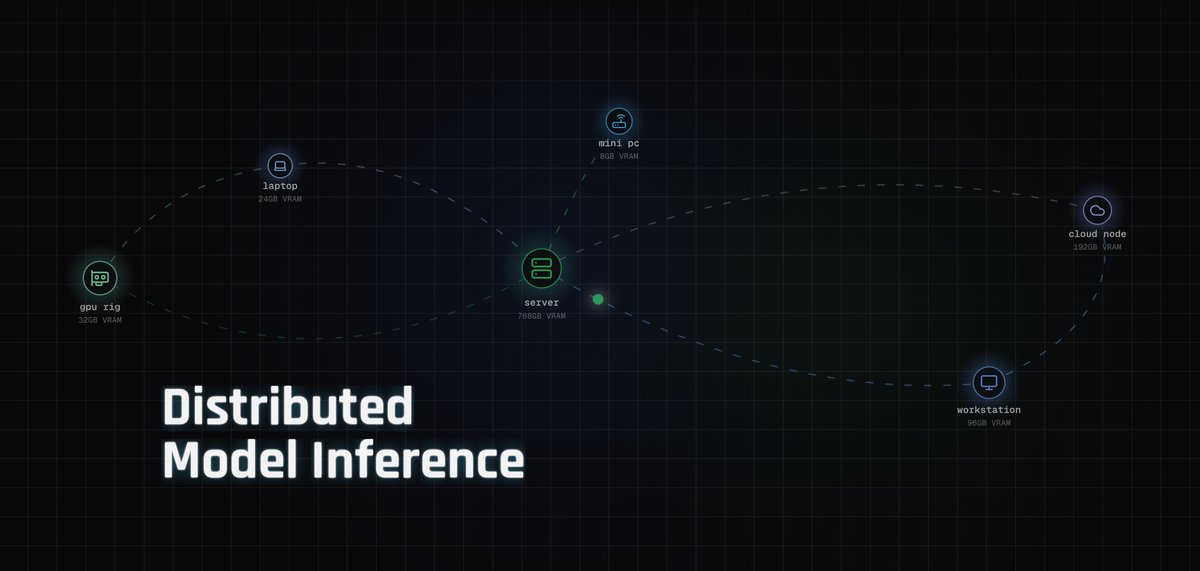
Imagine running a large language model not from a sprawling data center, but right from your laptop or a mini PC. That’s the promise of Mesh LLM, an emerging tech that’s flipping the script on AI computing. Instead of relying on centralized servers, it enables a network of devices—laptops, workstations, and even cloud nodes—to collaborate seamlessly. The best part? You can set up this system with just 18 MB of software, making it accessible to anyone with a decent setup.
As we dive into this, it's hard to ignore the implications. The idea of distributed model inference challenges traditional notions of AI deployment. No more metered APIs or convoluted setups. Instead, users can join a public mesh or configure a private deployment, all while keeping things lightweight and efficient. With a mobile app on the horizon, built on iroh's Swift SDK, the possibilities for real-time applications, from video streaming to IoT projects, are tantalizing. So, how does this shift affect the landscape of AI? Let’s explore what mesh computing could mean for developers and businesses alike.
Introduction to Mesh LLM
Mesh LLM is a significant player in the realm of distributed AI computing, primarily because it allows users to tap into large language models without the hefty hardware costs usually associated with them. With a lightweight installation size of about 18 MB, users can easily set up the software and either join a public mesh or configure it for private deployment. This flexibility is crucial for organizations that want to experiment with AI capabilities without investing in custom hardware infrastructures.
One notable aspect of Mesh LLM is the number of models it ships with, boasting a selection of over 235 billion parameters across various configurations. This variety means users can choose models that best fit their specific needs, whether that's for natural language processing, data analysis, or other AI-driven tasks. The potential here is impressive, especially when you consider that "iroh enables distributed compute without having to finagle custom hardware." The trade-off is that while it opens up access to powerful models, the latency over a network can hinder real-time applications. As one observer pointed out, "the throughput over a network is incredibly slow. It’s not usable for interactive use."
For developers looking to get started, integrating with Mesh LLM is straightforward. Here's how you can point your OpenAI client to the local instance of the Mesh LLM running on your machine:
import openai

openai.api_base = "http://localhost:9337/v1"
Moreover, the upcoming mobile app built on Iroh's Swift SDK promises to extend the capabilities of Mesh LLM even further. This could enable users to access and utilize these distributed models from their mobile devices, potentially broadening the scope of applications and interactions. Overall, Mesh LLM is carving out a niche in distributed AI, making advanced models more accessible, though it's not without its limitations.
Practical Usage and Code Integration
Integrating Mesh LLM with your existing AI applications is straightforward and effective. The software is lightweight, at just 18 MB, making it easy to install. Once set up, you can join the public mesh or configure your own instance. The Mesh LLM ships with a substantial number of models, totaling 235 billion parameters, which provides a robust foundation for various AI tasks.
To connect an OpenAI client to the Mesh LLM, you'll need to point it to the appropriate endpoint. Here's a simple code snippet to get you started:
This snippet configures the OpenAI client to communicate with your Mesh LLM instance running locally. It's crucial to keep in mind that while distributed compute can simplify scaling, the throughput over a network might be slow, which limits its usability for real-time interactions.
When integrating with existing applications, consider the architecture of your system. Depending on your use case, you might need to optimize how you handle requests to ensure performance remains acceptable. Users have reported that although leveraging distributed models is appealing, the additional network latency can be a bottleneck. It's worth experimenting with different configurations to find the right balance between performance and flexibility.
Performance and Model Availability
Mesh LLM ships with a robust collection of models designed for distributed computing, totaling around 235 billion parameters. This is a substantial number, especially considering the lightweight nature of the software, which is just 18 MB to install. Users can quickly set this up and either join the public mesh or configure their own environments, making it accessible for various real-world applications.
The performance of these models is intriguing, especially in the context of distributed architecture. While it's clear that having a large model pool offers flexibility, practical implementation often stumbles due to network limitations. As one user pointed out, "the throughput over a network is incredibly slow. It’s not usable for interactive use." This highlights a real challenge: while distributed computing can promise scalability and resource-sharing, it falls short when quick responsiveness is needed.
Despite this, the potential for non-interactive tasks is considerable. Using a local setup, you can easily point any OpenAI client to the Mesh LLM service. Here’s a short example to demonstrate how to do this:
This simple configuration allows access to the models efficiently, as long as the tasks align with the strengths of distributed systems. In scenarios where immediate feedback is not critical, Mesh LLM can efficiently handle large data processing, making it a practical solution for batch jobs or analytics. However, it’s essential to assess your specific use case before fully committing to this architecture.
Installation and Setup
The ability to install a lightweight software package of around 18 MB is significant for accessibility. It lowers the barrier for entry, which could lead to broader adoption, particularly among developers looking for distributed computing solutions without the need for specialized hardware. The option to join a public mesh or configure private deployments adds flexibility, catering to various use cases from casual experimentation to more serious applications. However, this adaptability comes with a set of implications that users need to consider.
While the community appreciates iroh's approach to facilitating distributed computing, concerns about slow network throughput for interactive applications are valid. Users are drawing parallels to existing platforms like cocompute.ai, questioning whether iroh can truly deliver on performance and security. The mention of a mobile app built on iroh's Swift SDK introduces an interesting avenue for accessibility but also raises questions about the user experience and practicality of mobile deployments in a distributed system.
In this context, I see potential for innovation, but also significant hurdles. If iroh can address performance and security issues effectively, it could carve out a meaningful niche in the distributed computing landscape. However, if these concerns remain unaddressed, the gap between expectation and reality may widen, leading to skepticism about the utility of the system. The community's mixed reaction suggests that while there’s interest, the road ahead requires careful navigation of technical challenges and user needs. How well iroh can manage this balance in the coming months will be crucial for its long-term relevance.
Conclusion
The idea of running large language models without the need for massive hardware is enticing, but the reality of Mesh LLM is still a mixed bag. With just 18 MB to install, it's easy to get started, and the allure of connecting various devices to form a distributed inference network is certainly appealing. But will most users truly benefit from this setup? The transition to a mesh system from the traditional data center model requires a mindset shift, and not everyone is prepared for that. As we see more users experiment with this technology, it'll be interesting to watch how incremental improvements affect performance and usability.
For now, if you’re looking for an alternative to conventional large language model access, Mesh LLM is worth a look. Just don’t expect it to replace your cloud service overnight. There's still a lot to figure out about how it fits into the larger AI ecosystem, and whether the trade-offs are worth it in practical applications.