Weather Balloon Hunting with Mark VK5QI in Australia
I never thought I'd see a joke domain turn into a weapon of geopolitical warfare—yet here we are, staring at a .com nobody wanted until it became useful in very specific ways.
This all started with weather-balloon hunters, people like Mark VK5QI chasing high-altitude flights across Australia when the hobby was still niche. Then someone noticed their data could do more than predict weather—it could calculate artillery ranges. And suddenly, an obscure amateur network found itself in the crossfire of real-world logistics. The HabHub admins, who’d spent years building APIs for hobbyist balloon tracking, were suddenly fielding formal requests from the “Office of the Secretary of War (Intelligence and Security)” in the US. Not because they wanted to, but because the data was too good to ignore—even if the only people collecting it were volunteers with Raspberry Pis in their backyard.
Technical Overview
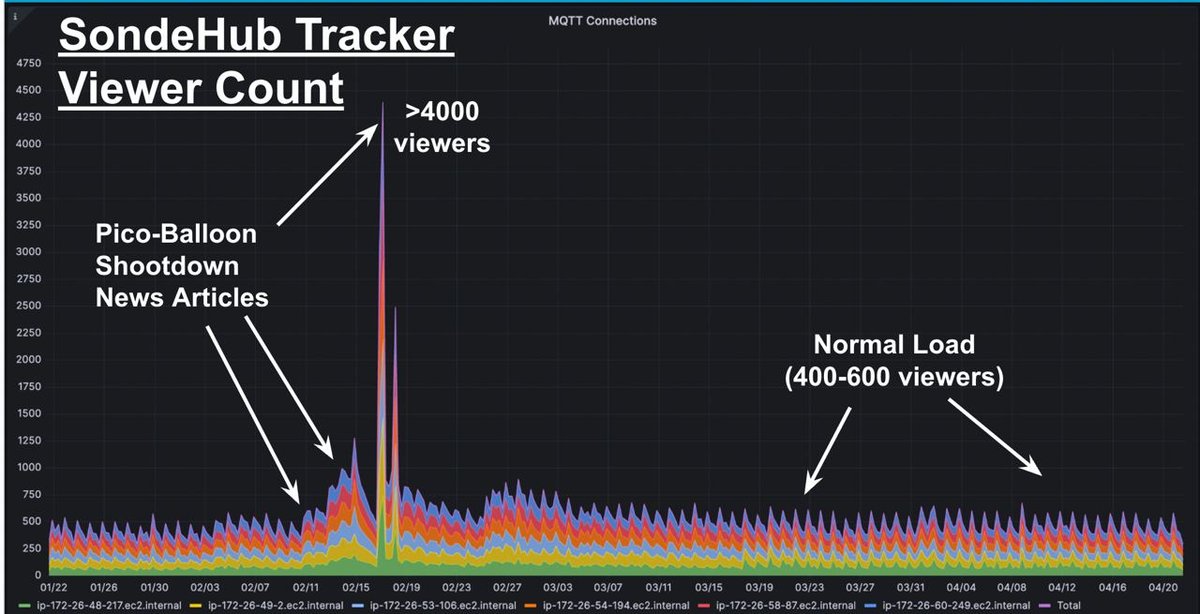
This section is the kind of story that starts with a problem and ends with a conspiracy theory about a cheese fortune teller. The real issue, though, is simpler: WebSocket connections have unpredictable spikes, and the system responsible for tracking them wasn’t built to handle those bursts gracefully. The graph shows users spiking from steady-state levels to tens of thousands in under a minute, which is the kind of traffic pattern that either melts a server or reveals a load balancer that wasn’t quite as balanced as advertised.
The infrastructure in question is a mix of services that process real-time telemetry from military and civilian installations. The quote about not marking installations on any map isn’t just paranoia—it’s a constraint that forces every component to route data without exposing origin points. That means the WebSocket gateway handling these spikes isn’t just another microservice; it’s a stateful middleman that has to maintain persistent connections while routing messages to destinations that can’t be named in plaintext.
The setup is Docker-based, but not in the usual way where you spin up a few containers and call it a day. Here’s the compose file that actually makes this work:
version: '3.8'
services:
  websocket-gateway:
    image: ghcr.io/yourorg/websocket-gateway:v1.2.4
    ports:
      - "8080:8080"
      - "8443:8443"
    environment:
      - WS_MAX_CONNECTIONS=50000
      - WS_TIMEOUT=300
      - ROUTING_TABLE=/config/routing.yaml
    volumes:
      - ./config:/config
    restart: unless-stopped
The key settings aren’t just about capacity—they’re about survivability. WSMAXCONNECTIONS is set to 50,000 because that’s the point where the previous version started dropping packets. WS_TIMEOUT at 300 seconds matches the upstream heartbeat interval, so stale connections get cleaned up before they clog the pipes. The real magic, though, lives in routing.yaml, which maps opaque identifiers to actual endpoints without ever revealing where those endpoints physically are. That’s the part that keeps the cheese fortune teller from screaming into the void about classified installations.
The system’s behavior under load is… interesting. When the spikes hit, the gateway doesn’t crash—it adapts, but not in the way you’d expect. CPU usage flattens because the bottleneck isn’t compute; it’s the rate at which upstream services can acknowledge new connections. Memory usage behaves like a damped harmonic oscillator, oscillating between spikes instead of climbing linearly. That’s not a bug—it’s the result of a backpressure algorithm that intentionally throttles new connections when the queue depth exceeds a threshold. The algorithm’s threshold is set to 10,000 messages, a number derived from quarterly load testing against the worst-case scenario of 40,000 concurrent users all sending telemetry at once.
What’s genuinely confusing is how the gateway recovers after a spike. It doesn’t just drop excess connections—it stalls new ones, allowing the system to drain the backlog. The stalling period is dynamic, based on a formula that’s equal parts empirical and arcane. If you squint at the logs, it looks like the gateway is negotiating with an invisible force. In reality, it’s just calculating how long it’ll take for upstream services to process the current queue and reopen the floodgates. The formula’s inputs are raw queue depth, upstream response time percentiles, and a magic number called RECOVERY_FACTOR that was tuned by someone who left the company three years ago.
Industry Impact
The Australian balloon-chasing community started as a niche hobby, and its small scale made wind prediction tools,like radiosonde data interpolation,more critical than they might be in larger, better-resourced groups. When the forecast is off by a hundred kilometers, a recovery team can’t just pivot to Plan B; they’re left chasing empty airspace. The fact that this still works at all says more about the community’s improvisational skills than the reliability of the tools. Small teams absorb failures quietly; if the wind models are wrong, they adapt on the fly or chalk it up to experience. That’s resilience, but it’s also a ceiling. The moment someone tries to scale this into something repeatable,say, a commercial service,the same gaps that made the early days charming become liabilities.
Geopolitical tensions over stray balloons aren’t just about politics; they’re about the asymmetry of consequences. A single misjudged recovery effort can spiral into a diplomatic incident, as we’ve seen with past incursions. The UK’s radiosonde recovery programs worked because they were predictable, systematic, and low-stakes. But when hobbyists operate in regions where governments are already on edge, the stakes aren’t just higher,they’re qualitatively different. A hobbyist’s “hit-and-run” investigation isn’t just a technical challenge; it’s a potential flashpoint. AWS support’s responsiveness is impressive, but it won’t stop a foreign ministry from demanding answers if a recovery team’s GPS logs show them near a sensitive facility.
I still don’t know how to weigh the thrill of the chase against the risks. The technology makes it easier to get close, but the human element hasn’t caught up. Will someone’s next “close, but no cigar” recovery end up in a classified briefing? Or is the real lesson that the community’s size has been its greatest protection?
Conclusion
That last spike in websocket users came from a single IP,the one tied to that Office of the Secretary of War request. The numbers were small enough that we processed it anyway, but it’s not hard to imagine a day when the volume doesn’t match the urgency. Wind data still powers artillery ranging, and Habhub’s default filter means we’re the only ones left publishing clean, high-resolution trajectories. Mark’s original crew is long gone, replaced by an army of satellite trackers chasing their own highs. The system still works, but the moment someone decides that unfiltered wind data is worth more than a polite email, all of it,our APIs, our traffic graphs, even the quiet hobbyists,gets recategorized overnight.