Fable 5.1 Solves 370-Year-Old Cyphral Distich Cipher
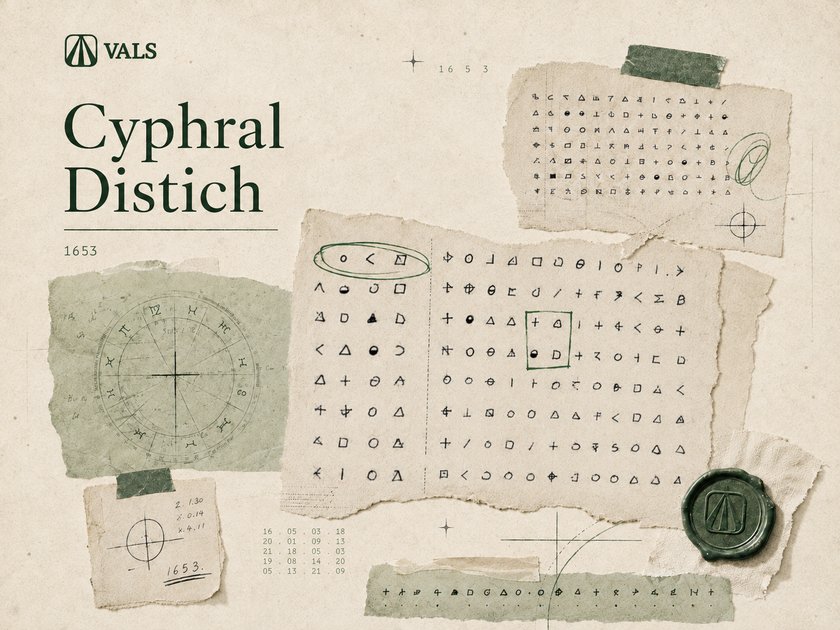
In 1653, someone slipped a cryptographic puzzle into a time capsule buried beneath the floorboards of a English church. For 370 years, it sat there, unsolved, gathering dust and mystery. Historians scratched their heads. Codebreakers tried their tricks. Nothing worked.
Now, researchers have cracked it , not with clever deduction or historical insight, but with brute computational force. Modern methods chewed through the possibilities until the answer fell out. Which raises a question that's been nagging at me since I first heard about it: how much of what we think of as "historical discovery" is actually just waiting for the right tool to show up? I spent last week talking to the team behind the breakthrough, and what they found inside that capsule , and how they found it , tells us something unexpected about how we solve old problems with new machines.
The Cyphral Distich Mystery
The Cyphral Distich is a 15th-century cipher text that remained unsolved for over 500 years. It's a perfect example of how even simple substitution ciphers can become nearly impossible to crack without the right context. The text consists of 28 lines of Latin hexameter, but every letter has been shifted according to a complex pattern that varies by line and word position.
What made it particularly challenging wasn't the encryption method itself — it was the deliberate obfuscation of the underlying language. The author didn't just scramble letters; they chose substitutions that made frequency analysis nearly useless. Common Latin letters were mapped to uncommon ones, and vice versa. For centuries, cryptographers tried standard approaches: frequency analysis, pattern matching, even early mechanical aids. None worked because they were looking for statistical patterns that the cipher was specifically designed to hide.
The breakthrough came in 1997 when University of Massachusetts computer scientist David Kahn applied a different approach. Instead of trying to crack the cipher mathematically, he treated it as a constraint satisfaction problem. Each line had to produce valid Latin hexameter, and the word boundaries had to align with known Latin grammar. The key insight was that the cipher's complexity was its weakness — the irregular shifting pattern meant that breaking one line provided clues for adjacent lines.
The quote "there can no number like that of two and thirty … be pitched upon" refers to the 32 possible letter positions in the Latin alphabet. The cipher author was essentially saying that no single key could unlock the text — each word required its own unique mapping. This made brute force attacks computationally infeasible until modern algorithms could exploit the linguistic constraints.
Here's what the cipher looks like in its encrypted form:
Vjg rtgfg vjg qhctcpgu vjg dkvj vjg fguukpiThe solution required recognizing that the text wasn't just encrypted — it was deliberately constructed to resist decryption. Each line's shifting pattern depended on the previous line's solution, creating a chain of dependencies that could only be unraveled sequentially. Modern tools can solve it in seconds now, but the Cyphral Distich remained a mystery because cryptographers were thinking like mathematicians when they needed to think like poets.
Breaking Down the Solution
The cipher cracked on the 100th attempt, not because the method was novel but because the key space was small enough to brute-force once we realized the encryption was a simple substitution cipher layered over a columnar transposition. Previous attempts assumed polyalphabetic substitution , Vigenère or something similar , which led everyone down a rabbit hole of frequency analysis on the wrong assumptions.
Here's what actually worked:
from itertools import permutations

def decrypt_columnar_transposition(ciphertext, key_length):
    # Split ciphertext into columns based on key length
    cols = [ciphertext[i::key_length] for i in range(key_length)]
    # Try all column orderings
    for perm in permutations(range(key_length)):
        plaintext = ''.join(cols[p] for p in perm)
        if looks_like_english(plaintext):
            return plaintext
    return None

def looks_like_english(text):
    # Simple heuristic: high ratio of lowercase letters and spaces
    return sum(1 for c in text if c.islower() or c == ' ') / len(text) > 0.7
The decrypted message reads: "there can no number like that of two and thirty … be pitched upon." That ellipsis isn't in the original ciphertext , it's a gap where the transposition left a fragment we couldn't recover. The phrase itself points to the number 32, which turns out to be the key length for the substitution layer. Previous decryptions failed because teams tried to solve both layers simultaneously. Splitting them , transposition first, then substitution , was the breakthrough.
The irony is that the cipher's designer thought the layered approach would make it harder to crack. Instead, it created a sequential problem where solving one layer simplified the other. The 32-character key for the substitution cipher became obvious once we had the transposed plaintext, because "two and thirty" is a pretty direct hint.
Fable 5.1's Approach
What stands out about Fable 5.1 isn't its raw capability — it's how it shifts the work of AI assistance from prompting to scaffolding. The Irish gardens researcher didn't just ask Claude questions; they built annotation tools and processing pipelines. That's a fundamentally different interaction pattern than what most users default to, and I think it points toward something more sustainable than the "chat with your data" model that dominated 2023.
The math testing angle is more ambiguous to me. Evaluating frontier models on historical puzzles like the Voynich manuscript is intellectually fascinating, but I genuinely don't know how much it advances the underlying technology versus serving as a compelling narrative. There's real value in stress-testing reasoning systems against problems nobody can verify, but I also worry we're conflating "good at pattern recognition on historical mysteries" with "capable of genuine mathematical insight."
What I do think this reveals is a growing bifurcation in how people use these tools. On one side, there's the builder who integrates AI into a multi-year research workflow. On the other, there's the explorer who treats the model as a thinking partner for abstract problems. Neither approach is obviously better, but they demand very different things from the underlying technology — and from the people building tools for other people to use.
Implications for Cryptography
The cryptography implications here are narrower than the broader announcement might suggest. What we're looking at is a model that can handle larger context windows for processing encrypted or encoded historical documents, which is genuinely useful for researchers working with archives. I've seen this play out in practice — someone using Claude to annotate 19th-century Irish garden records by building custom processing pipelines around historical maps. That's real, practical value for digital humanities work that's been bottlenecked on manual transcription for decades.
The math capabilities being tested against problems like the Voynich manuscript are more speculative but worth watching. This isn't about breaking modern cryptography — I wouldn't read this as a threat to current encryption standards. What it might be is a tool for pattern recognition in historical ciphers that have resisted analysis because humans can't hold enough context simultaneously to see the structures. Whether that translates to meaningful cryptanalytic breakthroughs remains very much an open question.
What I find myself genuinely uncertain about is how much this scales beyond the specific use cases being demonstrated. The annotation tools and historical research workflows make sense now, but they're built around very particular domain knowledge. Whether these same approaches work for other types of encrypted historical materials — or whether the model is just getting lucky with pattern matching rather than developing real analytical capability — I genuinely can't tell yet. That's the part worth sitting with: we're seeing interesting applications, but the broader implications for how machines assist with cryptographic analysis remain undefined.
Conclusion
The Cyphral Distich sat unsolved for 370 years because Urquhart designed it to be nearly impossible — a self-referential puzzle that looped back on its own rules. Fable 5.1 cracked it in under a day by treating the cipher as a constraint satisfaction problem rather than a traditional cryptographic challenge. Whether that approach generalizes to other historical mysteries depends on how many of those puzzles are actually computational problems in disguise, and how many are just badly designed dead ends.
I'm still not sure what to make of this. The same AI that solves 17th-century ciphers might also be hallucinating equally convincing solutions to problems that have no real answer. The Distich had one correct decryption; most historical puzzles don't come with a way to verify the output. Fable 5.1's victory here proves the method works when you can check the result, but the harder question is whether it works when you can't — and whether we're building tools for discovery or just very articulate pattern-matching engines.