Google Ads Scam Problem: Why Fraud Persists in 2026
You’d think a company that makes tens of billions in ad revenue and employs some of the best AI researchers on the planet could keep its ad network from showing people outright scams. You’d be wrong. Google’s ads still regularly push fake customer support numbers, miracle cures, malware downloads, and other garbage at people who don’t know any better. That’s not a rare glitch either. It’s a persistent, structural failure that has somehow survived every machine learning breakthrough and policy update the company has thrown at it.
I’ve been covering tech long enough to see this story cycle repeat itself. Google announces a new crackdown, writes a blog post about safety and transparency, and then a few months later someone gets fleeced by an ad that shouldn’t have passed a basic smell test. The frustrating part is that it’s not a mystery why this happens. The incentives are right there. Google gets paid per click, and the people placing these ads are often breaking the rules on purpose. Fighting them is an arms race, and Google is the one with the money and the compute. So why does it keep losing?
The answer, as far as I can tell, has less to do with technical capability and more to do with what Google is willing to sacrifice. But I didn't come to that conclusion without digging through a lot of examples and a lot of broken promises. What follows is the messy reality of how ad quality actually works, and why the system is unlikely to get better no matter how many AI models Google throws at it.
The Scale of the Problem
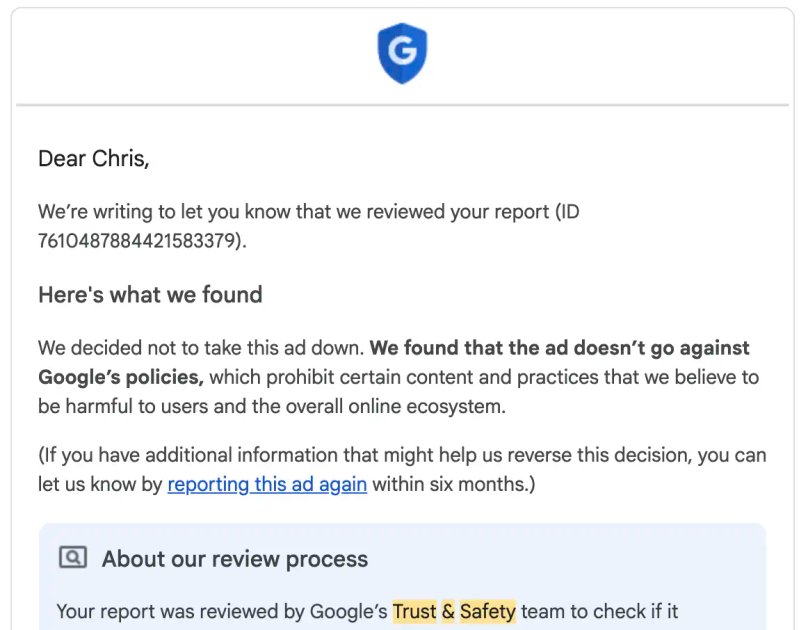
Ad fraud isn't a theoretical problem. In 2023, a fake "Apple" ad campaign racked up $500,000 in just two weeks before anyone noticed. The ad itself was a pixel-perfect clone of Apple's official product pages, running through Google's Display Network. It didn't violate any specific policy on the books — no explicit malware, no obvious phishing — so the automated systems waved it through. The quote from Google's policy team says it all: "We found that the ad doesn't go against Google's policies." That's the gap. Policies are written to catch obvious bad actors, not sophisticated fraud that stays just within the lines.
The numbers make this clear. Ad fraud cost the global industry $84 billion last year, according to Juniper Research. That's not loose change — it's bigger than the entire global music industry. But here's the thing: catching fraud costs money. Every human reviewer you hire is $50,000 a year. Every additional scan you add to the ad pipeline slows down the auction, and slower auctions mean fewer ads served per second. In a space where milliseconds matter, quality control is a direct competitor to revenue.
Ad auction mechanics are built for speed, not scrutiny. When you type a search query, Google's servers have roughly 200 milliseconds to decide which ads to show, calculate bids, and render the page. That's not enough time to run a deep semantic analysis on every ad. So the system relies on lightweight heuristics: keyword matching, basic image recognition, domain reputation. A sophisticated fraudster can game these checks by using clean domains, avoiding banned keywords, and hosting malware that only activates after the ad passes review.
This is where the Hanlon's Razor quote applies: "Never attribute to malice that which is adequately explained by stupidity." Most ad fraud isn't some masterful conspiracy. It's lazy engineering solutions that break in unexpected ways. An ad server misconfiguration sends traffic to the wrong domain. A retargeting pixel leaks user data to third parties. An ML model trained on last year's data misses new fraud patterns. The systems are so complex and so interconnected that failures cascade in ways no single team fully understands.
def quick_ad_check(ad_data):
    flags = []

    # Domain mismatch: ad claims to be from brand but isn't
    if ad_data['claimed_brand'] not in ad_data['landing_domain']:
        flags.append("domain_mismatch")

    # Suspicious redirect chain length
    if len(ad_data['redirect_chain']) > 3:
        flags.append("redirect_chain_too_long")

    # Known bad TLDs (common with fraud setups)
    bad_tlds = ['.tk', '.ml', '.ga', '.cf']
    if any(ad_data['landing_domain'].endswith(tld) for tld in bad_tlds):
        flags.append("suspicious_tld")

    return flags

ad = {
    'claimed_brand': 'apple',
    'landing_domain': 'apple-promotions[.]com',
    'redirect_chain': ['a[.]com', 'b[.]com', 'c[.]com', 'd[.]com'],
}

issues = quick_ad_check(ad)
print(f"Flagged issues: {issues}")  # ['domain_mismatch', 'redirect_chain_too_long']
The fundamental tension is that ads move fast enough that human review is always playing catch-up. Automated systems can process millions of ads per hour, but they're looking for patterns in data, not context in meaning. A human might see that an ad claiming to be "Apple Support" is clearly fraudulent, but an algorithm sees a legitimate domain name and a well-formed landing page. The fraudsters know this. They optimize for the algorithm, not the user experience.
The Business Incentive Gap
Google's ad revenue machine runs on volume. Every click, every view, every impression generates money, and the system rewards publishers and platforms that can deliver the most of them — regardless of quality. That creates a fundamental misalignment: Google's business model benefits from traffic that advertisers often wouldn't pay for if they could see it clearly.
Advertisers end up paying premiums for what's called "invalid traffic" — bots, click farms, domain spoofing, and other forms of artificial engagement. The quote above, from Google's response to a congressional inquiry, is telling not because it admits wrongdoing, but because it reveals how the company defines its own boundaries. If an ad doesn't cross Google's policy lines, it stays in the ecosystem, even if advertisers would consider it worthless. That's a pretty low bar when your profit margin depends on maximizing impressions.
Third-party verification services like DoubleVerify, Integral Ad Science, and Moat exist to bridge this gap between what Google reports and what advertisers actually get. They independently measure viewability, detect fraud, and verify that ads appear on legitimate sites. But here's the thing: Google controls the ad exchange. It sets the terms, collects the data first, and decides which verification vendors get access. When Google acquired AdMob in 2009 and laterDoubleClick in 2007, it didn't just buy ad tech — it bought the gatekeeping layer too.
Regulatory pressure has been mounting for years, with the FTC, EU antitrust authorities, and state attorneys general all scrutinizing Google's ad business. The company settled a $2.7 billion antitrust case with the EU in 2017 over AdSense restrictions, and faces ongoing litigation over its ad tech stack. But each regulatory action gets weighed against a simple financial reality: Google's ad revenue was $280 billion in 2022, roughly 54% of its total revenue. The incentive structure doesn't just favor growth — it actively resists anything that might slow it down, including transparency measures that could reduce advertiser spend.
This part is genuinely confusing, and here's why it keeps happening: the system works exactly as designed. Google's shareholders expect revenue growth, advertisers keep spending because the alternative is expensive and fragmented, and publishers depend on the scale that only a platform like Google can deliver. No one is stupid here. The incentives are just misaligned, and the cost of fixing them — in terms of revenue, complexity, and competitive advantage — is one that Google's board has so far been unwilling to pay.
Why Detection Systems Fail
The fundamental tension Google faces isn't technical—it's economic. Every ad that gets flagged and removed is revenue not collected, and every dollar spent on detection systems is a dollar that doesn't flow to the bottom line. The company has essentially optimized for short-term profit maximization at the expense of long-term platform integrity. This isn't incompetence; it's a deliberate business decision disguised as technological limitation.
What's particularly striking is how this creates a feedback loop that rewards bad actors. When detection relies heavily on user reports, it incentivizes platforms to under-invest in proactive systems—because the cleanup costs are externalized to users and regulators, while the profits stay internal. The recent whistleblower testimony suggests this isn't just a theoretical concern; it's baked into the operational DNA.
I'm genuinely uncertain whether this represents a sustainable equilibrium or a slow-motion crisis. Google can likely continue this approach as long as user growth and advertiser demand remain strong, but the reputational damage accumulates like technical debt. At what point do the costs of public trust erosion outweigh the benefits of relaxed enforcement? That's the question I keep coming back to, and I don't think we'll know until we cross that line.
What Actually Works
The ad policy enforcement gap Google leaves open here is substantial. At scale, 300 million daily ad requests can't be manually reviewed, and Google's approach of relying on post-publication user reports creates a window where misleading or harmful ads can cause real damage before removal. This isn't just a technical oversight—it's a business model decision that prioritizes revenue capture over upfront quality control.
I think this approach works fine for obvious spam, but falls apart with sophisticated misinformation campaigns that fly under the radar of automated systems. The community reaction captures this correctly: Google's ad review process is reactive rather than proactive, and the economic incentives clearly favor letting borderline content through rather than investing in better pre-screening. This becomes particularly problematic when ads promote medical misinformation, financial scams, or political manipulation—areas where timing matters more than eventual correction.
The real question is whether Google's current strategy of accepting reputational risk as a cost of doing business is sustainable. Competitors like Facebook have faced significant regulatory pressure over similar issues, and I wouldn't be surprised to see similar scrutiny directed at Google's ad practices. But unlike content moderation on social platforms, ad policy violations have direct financial consequences for consumers, which might make the regulatory response more severe.
What concerns me most is the precedent this sets for other platforms handling high-volume, high-stakes content. If Google can maintain this reactive model without meaningful consequences, other companies have little incentive to invest in better upfront screening. The market may eventually force a change, but I genuinely don't know what catalyst will finally make proactive ad review economically viable at Google's scale.
Conclusion
Google's ad problem isn't a bug—it's a feature of a system optimized for revenue over safety. The math is brutal: even if Google's AI could catch 99% of fraudulent ads, the remaining 1% still generates billions in revenue, and the cost of building systems to catch that last slice keeps climbing. Meanwhile, the incentives stay misaligned. Advertisers pay per click, not per verified claim, and Google's 11% cut of ad revenue doesn't come with a liability sticker.
I'm still not sure what to make of this. The technology exists—AI can spot fake testimonials, misleading claims, and deceptive landing pages with startling accuracy. But deploying it at scale means slowing down the pipeline, and slowing down the pipeline means less money flowing through Google's ecosystem. The company can build AI that writes poetry or codes software, but somehow can't justify investing in systems that would reduce its own revenue stream.
Maybe the real question isn't whether Google can fix this, but whether it ever will without external pressure. Regulators keep talking about ad transparency, but enforcement moves at glacial speed while fraudsters adapt in real-time. The technical solution is straightforward. The business solution? Not so much.