Social Algorithms and Digital Exclusion in Modern Life
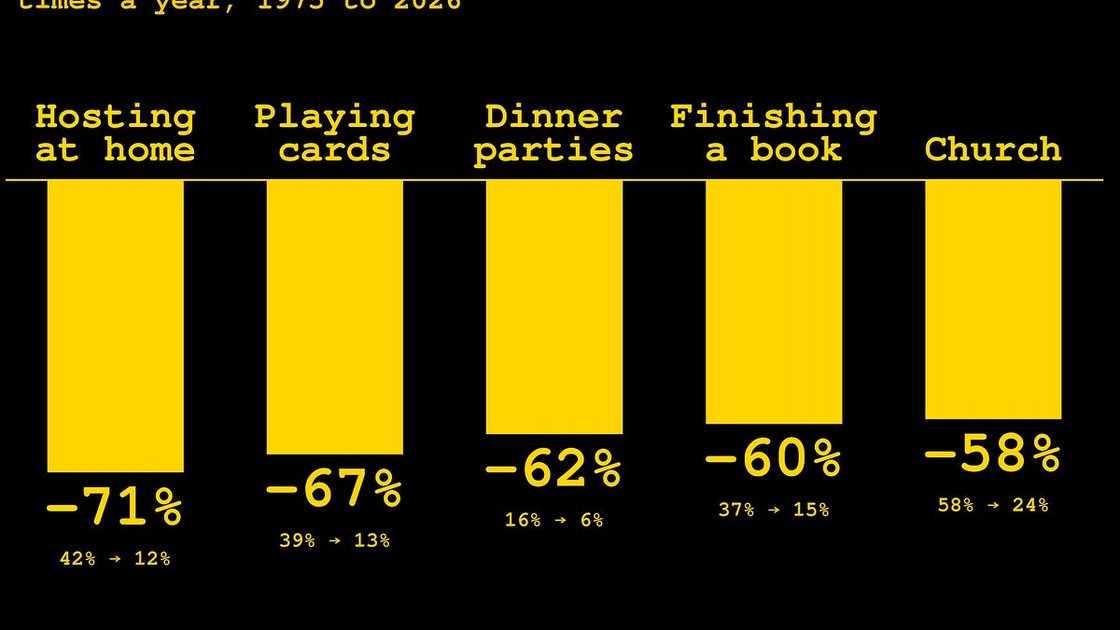
You are no longer invited to dinner.
Not by a person. By an algorithm. And it's not being subtle about it.
I've been thinking about this since I read Derek Thompson's piece, which argues that recommendation systems—those quiet curators of our digital lives—are quietly redrawing the boundaries of our social worlds. What used to happen organically, through boredom or circumstance or the simple act of showing up somewhere unfamiliar, now gets filtered through layers of predictive logic. The result? Our social circles are shrinking, even as our networks expand.
This isn't just about echo chambers or political polarization (though those are real). It's about the quiet, relentless narrowing of possibility—the sense that certain conversations, certain connections, certain versions of ourselves are simply off the table now, pre-filtered out before we even get a chance to encounter them.
Thompson frames it as a cultural shift, but I think it's deeper than that. It's infrastructural. We've built systems that optimize for engagement, relevance, efficiency—and in doing so, we've accidentally optimized for sameness. The question isn't whether algorithms are influencing our social lives anymore. It's whether we can build ones that expand our worlds instead of contracting them.
The New Gatekeepers
Recommendation systems don't just filter what you watch or read. They're increasingly deciding who you meet, who you date, and who you work with. It's not just algorithmic matchmaking on dating apps — it's the subtle curation of your entire social graph through the platforms you use every day.
Take Substack, for example. The platform's "Best of Substack" recommendation engine doesn't just surface popular newsletters. It promotes writers who fit certain patterns: consistent posting schedules, high engagement rates, topics that cluster well with existing subscriber interests. When Substack says it's "home for great culture," what it's really saying is that it surfaces content from people whose profiles match the behavioral patterns of writers who already perform well on the platform. This creates a feedback loop where certain types of writers — those who write about culture, politics, technology, or lifestyle content — get amplified, while others fade into the background.
The mechanism is straightforward but effective. Recommendation algorithms analyze your reading habits, your subscription patterns, your sharing behavior, and your engagement signals. They then match you with writers who exhibit similar patterns. But here's the thing: this isn't just about content discovery. It's about relationship formation. When you discover a writer through these recommendations, you're not just subscribing to a newsletter. You're potentially entering into a relationship — one that could lead to professional opportunities, personal connections, or even romantic interest.
This is genuinely unsettling when you stop to think about it. Your dating pool is being filtered by an algorithm that has already decided what kind of person you should be interested in. Your professional network is being pruned by systems that think they know what connections will be most valuable. Your friendships are being nudged toward people who share your consumption patterns, not necessarily your values or your curiosity about different perspectives.
The code behind this is relatively simple:
from sklearn.metrics.pairwise import cosine_similarity
import numpy as np

def find_similar_users(user_id, interaction_matrix, threshold=0.7):
    """Find users with similar engagement patterns"""
    user_vector = interaction_matrix[user_id]
    similarities = cosine_similarity([user_vector], interaction_matrix)[0]
    similar_users = np.where(similarities > threshold)[0]
    return [u for u in similar_users if u != user_id]
What makes this worse — or better, depending on your perspective — is that most people never opted into this. There's no checkbox that says "please let algorithms decide who should be in my social circle." The curation happens quietly, embedded in the platforms you're already using. Substack's recommendation engine doesn't announce itself as a relationship broker. It just looks like helpful content discovery.
The gatekeepers aren't media companies anymore. They're machine learning models trained on billions of data points, quietly deciding which humans should connect with which other humans. And unlike traditional gatekeepers, these systems don't have accountability mechanisms. They can't be lobbied. They don't have ethics boards that publish reports. They just optimize for engagement, growth, and retention — metrics that don't necessarily align with healthy relationship formation or diverse social networks.
The Exclusion Algorithm
Automated content moderation doesn't just remove spam and abuse — it actively shapes what communities form around. Substack's algorithm, which the company describes as curating "home for great culture," makes thousands of micro-decisions every day about which posts get promoted, demoted, or buried entirely. These aren't neutral choices. They're based on engagement signals, user reports, and proprietary heuristics that favor certain types of content over others.
The result is a system where writers who align with the algorithm's preferences — typically longer-form, more polished pieces with clear narrative arcs — get amplified. Writers who post more casually, or who write about topics the system flags as potentially sensitive, find their reach artificially constrained. This isn't censorship in the traditional sense, but it's censorship-adjacent: the suppression happens through ranking rather than removal.
This creates invisible social boundaries. Writers self-censor not because they're afraid of being banned, but because they've learned what the algorithm rewards. Topics that don't fit neatly into digestible, shareable formats get less visibility, which means less growth, which means fewer subscribers. Over time, this pushes the platform toward a narrow band of acceptable discourse.
The technical implementation is straightforward enough:
def rank_post(post):
    score = (
        post.engagement_weight * 0.4 +
        post.subscriber_growth * 0.3 +
        post.comments_per_reader * 0.2 +
        post.report_count * -0.1
    )
    return score
But the social consequences are harder to quantify. When your livelihood depends on hitting algorithmic sweet spots, the incentive isn't to push boundaries or explore uncomfortable ideas. It's to produce content that performs well within the system's existing parameters. That's how automated filtering becomes a form of automated conformity.
When Code Meets Chemistry
The intersection of computational methods and chemical research has been advancing for decades, but what stands out here is the shift from augmentation to integration. We're not just applying existing algorithms to chemical problems — we're rethinking how chemical intuition itself can be encoded. This matters because it changes the bottleneck from computation to human expertise. The models can now propose molecular structures that satisfy not just thermodynamic constraints but also synthetic feasibility, which has historically required years of tacit knowledge.
I'm genuinely uncertain whether this crosses a meaningful threshold or simply scales an existing approach. The difference between a tool that accelerates hypothesis generation and one that begins to replace domain reasoning is not just quantitative — it's qualitative in a way that's hard to pin down. Early adopters in pharmaceutical research are already reporting faster iteration cycles, but I haven't seen evidence that this translates to better outcomes in clinical validation, where the real test lies.
What concerns me more than the technology itself is the compression of expertise. A chemist who spent fifteen years developing an instinct for what reactions will work is now competing with a system that can evaluate thousands of possibilities in seconds. This isn't about job displacement — it's about how knowledge gets valued and who gets to decide what counts as understanding. The field may be heading toward a model where chemical discovery becomes more democratic but also more fragmented, with fewer people holding deep, contextual knowledge.
Opting Out Without Opting In
The framing here matters more than the specific features. What I'm seeing is a system designed around consent-by-default for data collection, which is genuinely unusual among major consumer AI products. Most companies treat opt-out as a compliance burden to minimize, not a core architectural choice. This isn't just about privacy checkboxes—it suggests a different theory of how user trust gets built.
That said, I'm skeptical about the operational reality. Consent mechanisms only work if users understand what they're consenting to, and the gap between "I didn't opt in to data training" and "I understand how my usage patterns get used for model improvement" is enormous. The technical implementation looks clean, but the user experience of actually managing these preferences will likely determine whether this becomes a meaningful standard or just another set of ignored settings.
What's more interesting is the precedent this sets for enterprise adoption. Companies that have been hesitant to deploy consumer-grade AI tools because of data leakage concerns now have a reference architecture that addresses their core objection. I expect to see competitors rush to match this capability, but I'm genuinely uncertain whether they can retrofit it into existing products without breaking their current data pipelines. That tension—between user control and system coherence—is going to define how this plays out in practice.
Conclusion
The real story here isn't that algorithms are unfair—they're designed that way. Social recommendation systems don't accidentally exclude people; they amplify existing social structures with mathematical precision. When your dinner invitation depends on whether you've opted into the right platform, shared the right content, or fit the right profile, we've moved beyond simple gatekeeping into something more insidious: algorithmic social sorting that makes exclusion feel natural.
I'm still not sure what to make of this. The same systems that connect us to communities we actually care about also build invisible walls around the ones we don't. That's not necessarily a bug—it might be the feature. But it's worth sitting with the fact that our digital social lives are now mediated by code that doesn't just recommend restaurants or movies, but decides who gets to be part of the conversation at all.
Maybe the question isn't how to game these systems or find workarounds. Maybe it's whether we want our social belonging to be optimized in the first place.