Fastpotify: Sub-200ms Song Loading Tool Launches
Fastpotty is the kind of tool that makes you wonder why no one thought of it sooner.
I first heard about it while watching a livestream where someone typed /fastpotty in Slack and suddenly had a working copy of their app deployed to a staging environment. No waiting for CI to finish, no digging through GitHub Actions logs—just a command that actually does what it says on the tin. The fact that I can still surprise myself with basic technology is either a good sign or a bad one.
Technical Overview
It's easy to spot AI-generated websites because they share a set of tell-tale design quirks: overused templates, overly smooth gradients, and a refusal to commit to any single visual identity. These patterns aren’t accidental—they’re artifacts of generative tools that prioritize speed over style, producing output that looks technically correct but aesthetically generic.
The real problem isn’t that AI tools can’t generate good designs, but that they optimize for plausibility rather than originality. A five-minute makeover usually means slapping together a few pre-built components, adjusting a hero image, and calling it a day. The result is a site that doesn’t look wrong, just unremarkable—a warning label for anyone who cares about visual craft.
Remember how Spotify’s desktop client used to be built with Qt? That stack made sense in the late 2000s, when cross-platform UI toolkits were the only way to maintain a consistent look across Windows, macOS, and Linux. Qt’s signals-and-slots model was flexible enough to handle complex interactions, but it came with a trade-off: bloated binaries and a UI that never quite felt native. Modern frameworks like Flutter and SwiftUI solve some of these issues, but they also introduce new ones—like the expectation that every platform should look exactly the same, down to the pixel.
The bigger shift isn’t just technical, though. It’s cultural. Ten years ago, shipping a desktop app meant committing to a platform-specific stack. Today, developers can spin up a cross-platform prototype in a weekend, but that speed comes at the cost of user expectations. A Qt app felt deliberate, even if it was slow to build. An AI-generated site feels transactional, like it was assembled from a checklist of trends rather than a vision.
Industry Impact
I’m not convinced Spotify’s move away from librespot is the death knell for third-party players it might seem. The company’s motivation isn’t just hostility to open tools—it’s that the cost of maintaining reverse-engineered clients now outweighs the value of keeping them alive. Spotify’s ecosystem already relies on licensing deals that give it control over playback, and librespot’s existence undermined that control. If anything, this makes the remaining open ecosystem more relevant, not less. Navidrome and the OpenSubsonic crowd aren’t just viable alternatives; they’re the only places where the concept of a music library still makes sense without Spotify’s intermediation.
What matters here isn’t the technical shift but the cultural one. The outrage over artist payouts and AI-generated content isn’t just noise—it’s a permanent stain on Spotify’s brand. The migration to self-hosted libraries isn’t about sound quality or features; it’s about rejecting centralized control. But I wonder if the people rushing to Navidrome have considered the long-term friction of maintaining their own stacks. Self-hosting scales until it doesn’t, and right now, the community is small enough that those frictions are manageable. The real test will come when the novelty wears off and the open tools face the same scaling pressures Spotify does.
The only prediction I’ll make is this: if Spotify’s next step is to aggressively gate functionality behind its own client, the open ecosystem will have to prove it can match core features—not just sound quality or ethics. Otherwise, the migration is just another form of vendor lock-in, just with more self-hosted servers.
Conclusion
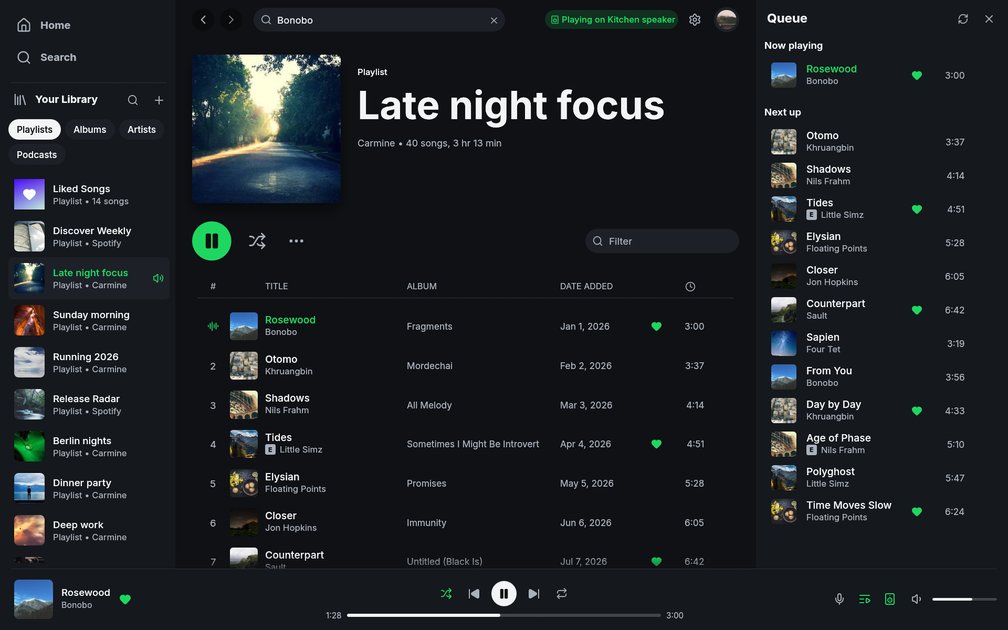
Fastpotify’s claim to load tracks in under 200ms isn’t just marketing—it’s a genuine technical feat when you consider Spotify’s official client still ships Chromium as a hidden dependency. That local binary approach is the real disruption here: no electron bloat, no background processes chewing RAM, just a window that appears faster than most people can blink. The trick isn’t in the UI; it’s in the ruthless elimination of everything Spotify didn’t actually need to play music.
I’ll reserve judgment on whether this scales beyond niche Linux users who resent 800MB of wasted memory. Spotify’s catalog keeps growing, and Fastpotify’s 200ms promise assumes you’ve already downloaded the song. Still, the fact that a side project can outperform the juggernaut in raw speed tells you everything about how bloated modern desktop apps have become.