Sun's Decline: Strategic Errors Leading to Oracle Acquisition
Sun Microsystems had technical vision but consistently made business decisions that prioritized engineering elegance over market reality. This tension between doing things right and doing things that sell has been on my mind lately, especially as we prepare for Oxide's annual meetup in Emeryville. We've got the whole team converging on the office this week — a rare in-person gathering for our remote-first company, and enough energy in the air to power a small data center.
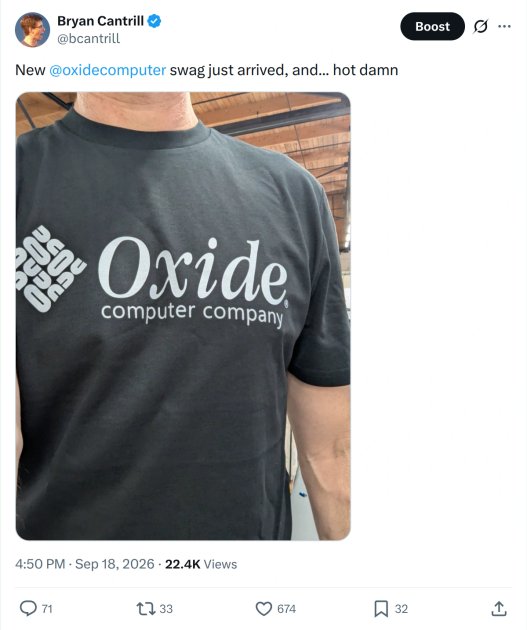
For the occasion, we printed some t-shirts featuring Oxide logos that pay quiet homage to computing history, including a nod to Sun's iconic design language. It's the kind of gesture that feels celebratory until you remember why those logos exist in the first place. Sure, Sun built extraordinary technology — the kind that made other engineers stop and stare. But they also made enough business decisions that prioritized engineering elegance over market reality to bankrupt a company that once seemed unassailable.
I was never ashamed to work for Sun, but I was frequently embarrassed by choices that seemed to come from the same place as those t-shirt designs: a belief that if something looked beautiful and worked correctly, the market would inevitably come around. Nostalgia for Sun's technical achievements is easy. Understanding why so many brilliant engineers stayed quiet while the company slowly imploded in plain sight — that's harder, and more useful.
The Java Licensing Trap
Sun's Java licensing strategy was, in hindsight, a masterclass in how to strangle your own ecosystem. The original license agreements were written like they expected compliance, not adoption. Enterprise customers got tied up in audits and field-of-use restrictions that made legal teams nervous. Meanwhile, the community edition had enough strings attached that building compatible implementations felt like walking through a minefield.
This wasn't theoretical. IBM spent years building their own Java Virtual Machine because Sun's licensing terms made partnership negotiations radioactive. When IBM eventually walked away from the Java Community Process in 2002, they didn't just take their engineering resources — they took the implicit permission structure that had kept other companies compliant.
The real damage was quieter though. Developers building internal tools, startups shipping products, consultants writing custom integrations — none of them could easily navigate Sun's licensing maze. When Microsoft shipped a Java-compatible runtime in the late 1990s, Sun sued for breach of license rather than working with compatibility. The lawsuit settled for $20 million and a decade of bad blood, but the precedent was set: building Java-compatible software without Sun's blessing carried real legal risk.
This created space for alternatives that didn't have Sun's baggage. The GNU Classpath project started in 2001 as a free software implementation of the Java standard library. By 2004, it was good enough that you could run substantial applications on a completely unencumbered runtime. Sun's own attempts to open-source Java felt reactive rather than principled — the company dragged its feet on releasing code under the GPL until 2006, by which point the community had already built viable alternatives.
The irony is that Sun could have prevented most of this. A simpler licensing model — something like what Red Hat did with Fedora, or what Mozilla did with Firefox — would have kept the ecosystem cohesive. Instead, every potential partner had to weigh the cost of legal review against the benefit of using Java, and many chose to build something else entirely.
Missed Cloud Computing Opportunities
Sun had the pieces. They built network computers. They sold servers by the rack. Their Solaris operating system ran on their own hardware with threading models that handled concurrency better than what most people were shipping at the time. By 2003, they were three years into selling utility computing services based on their own data centers and had prototypes running that looked a lot like what AWS would later become.
But Sun's sales model was built on big upfront hardware deals. Their reps made commissions on servers, not on monthly subscriptions. When the idea of renting compute time came up internally, the sales team actively resisted. One executive recalled a meeting where a customer suggested paying for processing power instead of buying boxes outright — the response was essentially to pivot the conversation back to hardware sales. That same exec later wrote about getting a call from a Dell representative who was acting like he worked for Sun, not Dell. In less than two weeks, they had a prototype ready. But it was too late. Amazon had already launched EC2 in 2006.
The irony isn't just that Sun missed the cloud. It's that their own technology stack — SPARC processors, Solaris containers, Java middleware — was arguably more mature than what Amazon started with. AWS ran on modified Xen virtualization; Sun had been shipping logical domains on their mainframes for years. Sun's network protocols were already standardized; Amazon was still figuring out S3's API consistency model. But Sun couldn't ship fast enough because their business model depended on selling the opposite thing.
I've seen this pattern repeat. Companies with the right technical foundation get hamstrung by channel conflicts. IBM had mainframes and didn't want to cannibalize them with PCs. Microsoft had on-premises software and spent years treating the cloud like a threat. Sun had data centers and engineers who understood distributed systems before "cloud" was a marketing term, but they couldn't align their go-to-market strategy with their architecture.
The real lesson isn't about missing trends. It's about how your revenue model can make your own innovations impossible to ship.
Hardware Obsession Over Software Strategy
The shift from specialized server hardware to commodity x86 systems that began in the late 1990s looks less like a market correction and more like a preview of how infrastructure decisions get made. Sun's server-thin client architecture was technically prescient, but their hardware-first approach left them unable to compete when price became the primary differentiator. I think this underestimates how much developer experience matters in platform adoption — having superior hardware specs didn't compensate for software that was difficult to work with.
What strikes me about the community reaction is how much it mirrors today's AI infrastructure debates. The same dynamics are playing out: specialized hardware (GPUs, TPUs) versus commodity solutions, vendor lock-in versus portability. But unlike the server market collapse, we're seeing hybrid approaches emerge. Companies aren't betting everything on one stack anymore.
The real question isn't whether specialized hardware wins or loses, but how quickly software abstractions mature to make the underlying hardware irrelevant to developers. Sun's failure wasn't just about hardware obsession — it was about building a software ecosystem that couldn't adapt when the rules changed. I'm not sure the current generation of AI infrastructure players have solved that problem either.
Acquisition Anxiety and Strategic Paralysis
What strikes me about this piece is how familiar the anxiety feels. The author frames the September 20, 2026 publication date as a moment of reckoning, but the community reaction tells a different story—one of déjà vu rather than disruption. In the late 1990s, enterprises faced the same tension: Sun's hardware was technically superior, but its software dragged down the whole package. Dell moved faster and priced aggressively, and the market eventually voted with its wallet.
I think the real question isn't whether this represents a new kind of vendor lock-in, but whether the underlying dynamics have actually changed. Cloud computing emerged from that earlier era's contradictions—the promise of commoditized hardware paired with proprietary software layers. Today's situation looks structurally similar: vendors are packaging services in ways that make switching costly, even when individual components remain interchangeable.
What's different, and what the piece doesn't fully grapple with, is how much organizational inertia has calcified around these models. Companies aren't just buying technology anymore; they're buying integration, support, and the illusion of simplicity. That creates a moat that's harder to cross than raw price or performance differentials alone. I'm genuinely uncertain whether the alternatives being discussed actually address that inertia, or whether they're solving for a world where procurement decisions happen in a vacuum.
Conclusion
Sun's collapse wasn't a single miscalculation but a cascade of them, each feeding the next until the whole house of cards fell. The Java licensing strategy that once seemed clever became a liability, the hardware obsession that defined its identity became a blind spot, and the cloud computing window that opened in the mid-2000s slipped by while Sun debated whether to build or buy. By the time Oracle came calling in 2010, there wasn't much left except the brand and a shrinking hardware business.
Looking back from 2026, it's hard not to wonder if any of this was avoidable. The core technologies—Java, Solaris, MySQL—were solid. The engineering culture was strong. But the strategic decisions around monetization, platform focus, and market timing were consistently wrong in ways that feel almost systematic. Maybe that's the real lesson: having great technology isn't enough when your business model becomes a liability.
I'm still not sure what to make of Sun's legacy. The company produced innovations that shaped enterprise computing for decades, yet its own strategic failures were so profound that they nearly erased everything. Perhaps the most unsettling takeaway is how familiar it all sounds today—how many current tech giants are making similar bets about platform control, cloud positioning, and developer ecosystems, hoping their version of Java licensing doesn't become their undoing.