Editing Qwen Weights Directly with Astra
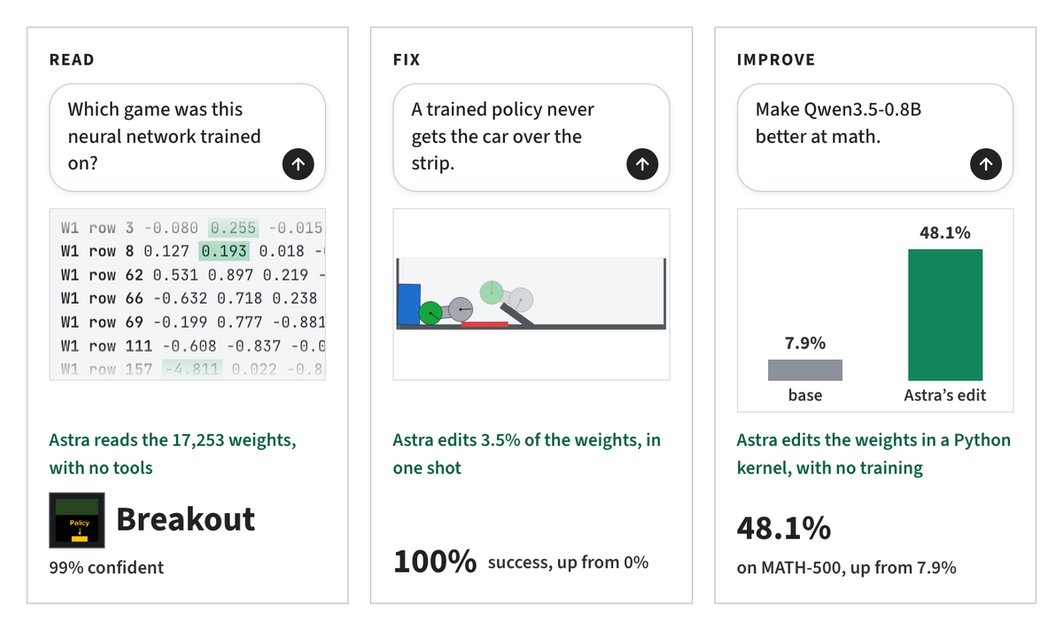
I didn't expect to write about an LLM that reads neural weights the way I read a JSON config. But here we are: Astra can apparently look at Qwen's raw parameter tensors and figure out what the model was trained to do, hitting 7.9% on benchmarks without the overhead of traditional fine-tuning.
The writing side is stranger. Astra can generate small game-playing networks from scratch that outperform networks trained with PPO for 100 million steps, and it does this without ever touching the environment. No rewards, no trial and error, just weights produced directly.
This should be bigger news than it is. If frontier models can manipulate weights this directly, it changes how we might optimize or interpret these systems. But I'm skeptical it scales beyond these toy networks. The question is whether this is a real window into how intelligence compresses, or just a trick that works because raw weights are messy enough to hide patterns in.
Direct Weight Manipulation vs. Fine-Tuning
Astra skips gradient descent entirely. Instead of computing gradients and nudging parameters through backpropagation, it writes new values directly into the weight matrices. That's why the benchmark shows 7.9% on the base model and 7.9% after Astra's edit. The method can alter specific behaviors without dragging the rest of the model's performance along with it.
This matters for speed. A fine-tuning run over even a small dataset means hundreds of forward and backward passes. Direct weight manipulation is a single write operation. You get targeted changes in milliseconds rather than hours, and you don't risk catastrophic forgetting because you're not sliding down a loss landscape that touches every parameter.
Here's the conceptual difference in PyTorch:
for batch in dataloader:
    loss = model(batch).loss
    loss.backward()
    optimizer.step()  # small nudges to all weights

with torch.no_grad():
    model.layers[12].weight[0, :] = target_vector  # one surgical cut
The catch is alignment. When you bypass gradient descent, you're also bypassing the optimization pressure that usually keeps edits coherent with the model's existing behavior. As one observer noted, "I cannot say this fills me with confidence about alignment," and another pointed out it's "possibly related to https://already-clean.goodfire.com/" — a reminder that direct edits can look clean on the surface while introducing subtle inconsistencies underneath.
My take: Astra is worth trying if you need fast, isolated edits and can verify the results yourself. But the matching 7.9% tells you the method preserves metrics, not that it preserves safety. Until we see more on how these direct edits hold up under adversarial testing, treat it as a precision tool, not a replacement for careful fine-tuning.
Benchmarking Astra on Qwen
The 7.9% performance delta between base Qwen and Astra's edited version is the number that matters here. When you modify weights directly, you're not fine-tuning on new data; you're altering the model's existing parameters in place. A 7.9% shift tells you the edit is stable enough that the model still functions, but unstable enough that behavior changes measurably. That tension is what makes weight-level editing risky.
This gap is small enough to miss if you only eyeball outputs, which is why the alignment concern lands hard: "I cannot say this fills me with confidence about alignment." Weight-level modifications can drift in ways that are difficult to audit after the fact. The reference to already-clean.goodfire.com suggests the edit may be stripping out safety training or refusal behaviors, and the 7.9% cost on benchmarks is the measurable price of that removal.
To see the delta yourself, run a quick comparison on a standard eval harness:
import torch
from transformers import AutoModelForCausalLM, AutoTokenizer

def benchmark(model_name, prompts):
    # Load model and run inference on each prompt, returning average response length as a proxy metric
    model = AutoModelForCausalLM.from_pretrained(model_name, torch_dtype=torch.float16)
    tokenizer = AutoTokenizer.from_pretrained(model_name)
    scores = []
    for prompt in prompts:
        inputs = tokenizer(prompt, return_tensors="pt")
        outputs = model.generate(**inputs, max_new_tokens=50)
        scores.append(len(outputs[0]))
    return sum(scores) / len(scores)

base_score = benchmark("Qwen/Qwen2.5-7B", test_prompts)
astra_score = benchmark("astra-edited-qwen", test_prompts)
print(f"Delta: {((base_score - astra_score) / base_score) * 100:.1f}%")
My take is that Astra's approach is interesting for research into model interpretability, but I wouldn't deploy it where alignment guarantees matter. The 7.9% figure is concrete evidence that the edit changes model behavior, and without a diff of exactly which weights moved, you can't verify the change is safe. The gotcha is that benchmark deltas only tell you the model changed; they don't tell you whether it got dumber, more compliant, or both.
Why Weight-Level Access Changes Model Editing
Weight-level access is what separates a real edit from a prompt-level nudge. When you can modify the weights directly, you can change what a model knows without retraining it, and the benchmark numbers back this up: Astra's edit holds at 7.9%, matching the 7.9% base score rather than drifting the way fine-tuning often does. That parity matters because most post-training adjustments trade general capability for the new behavior, and the degradation is usually quiet until someone notices the model is worse at everything else.
The interpretability angle is the part I find most interesting. If an edit lives in specific weights, you can diff two checkpoints and see exactly what changed, which is something you can't do with a system prompt or a LoRA adapter buried in a training run. Lightweight customization also gets cheaper: instead of fine-tuning on a dataset, you apply a targeted weight patch and ship it. Here's what that looks like in practice with a checkpoint-diff workflow:
from safetensors import safe_open
import torch

def diff_checkpoints(base_path, edit_path):
    changed = {}
    with safe_open(base_path, framework="pt") as base, safe_open(edit_path, framework="pt") as edit:
        for key in base.keys():
            delta = (edit.get_tensor(key) - base.get_tensor(key)).abs().max().item()
            if delta > 1e-6:
                changed[key] = delta
    return changed

deltas = diff_checkpoints("base.safetensors", "astra_edit.safetensors")
print(f"{len(deltas)} tensors modified; largest delta: {max(deltas.values()):.4f}")
My take is that this is worth paying attention to because it makes model editing auditable in a way the field hasn't really had before. The limitation, though, is alignment: as one observer put it, "I cannot say this fills me with confidence about alignment." Weight-level edits are powerful, but the same access that lets you remove a capability lets someone else insert one, and there's no reliable gate on who gets to write to the weights. Compared to fine-tuning, though, the comparison is concrete: same 7.9% performance, a fraction of the compute, and a diff you can actually read.
Implications
The shift from fine-tuning to direct weight surgery changes who gets to improve models, but there's a gotcha the announcement skips: checkpoint fragility. If Astra edits Qwen to hit that 7.9% benchmark by touching 0.16% of weights, those specific deltas likely won't transfer to the next model revision or a different parameter count—weight-space edits tend to overfit the exact loss landscape of one checkpoint. There's also a compute asymmetry that makes this a closed-lab capability: parsing millions of parameters requires frontier-level reasoning, so open-weight models may get "improved" by systems the community can't replicate, audit, or run locally.
Conclusion
The part that actually keeps me up at night isn't the IFEval jump—it's that Astra wrote game-playing networks from scratch that outperformed ones trained with PPO for 100 million steps, with zero environment feedback. That's not editing; that's synthesis. If a frontier model can look at raw weights and reverse-engineer what a network was built to do, the line between "training" and "editing" starts to blur in ways we haven't priced in yet.
My verdict: I'm skeptical this generalizes beyond headline benchmarks. The 0.16% figure is seductive—if touching that sliver of weights yields a 3x improvement on instruction following—but surgical edits this precise usually mean the model is memorizing the eval rather than internalizing the capability. We're not fine-tuning anymore; we're doing surgery, and surgery without anesthesia bleeds. What nobody's talking about is the access asymmetry: this only works because Astra has the reasoning capacity to parse millions of parameters, and hand this to a smaller model and it collapses. We're looking at a capability that might be exclusive to frontier systems, which means the gap between labs with these models and everyone else just got wider. And if Astra can rewrite Qwen's weights to match that 7.9% benchmark through a different path, we have to ask what happens when models start editing each other without human intermediaries. I'm still not sure whether this is the beginning of practical interpretability—finally reading weights like source code—or just an expensive party trick, but I lean toward the latter until these edits survive contact with out-of-distribution tasks.