Old Bitly Links Are Being Hijacked for Gen Z Jokes
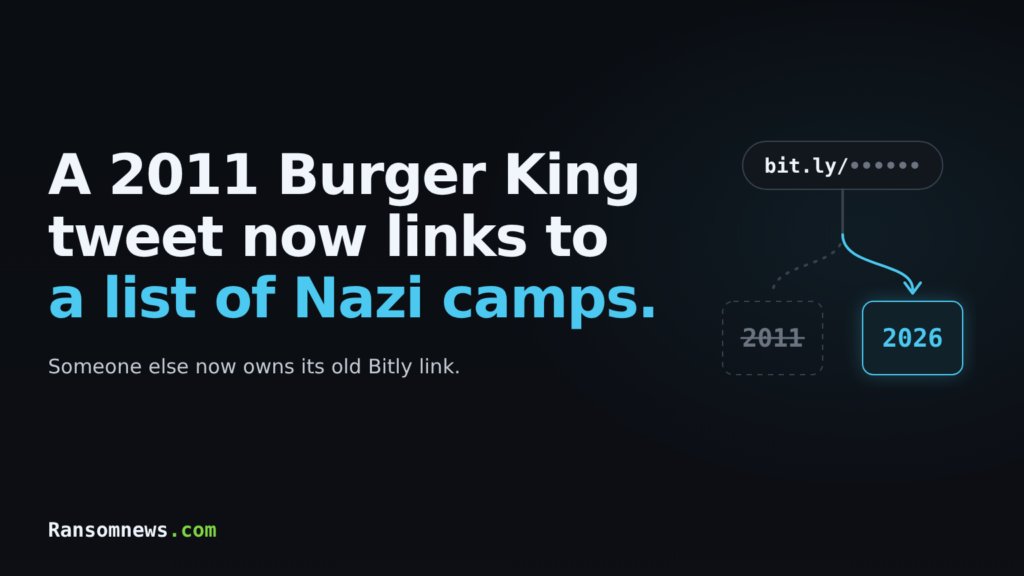
When McDonald's Sweden tweeted a celebratory message with a Bitly link, the link didn't go to their website. It went to the Wikipedia page for September 11. The joke landed so perfectly that dictionaries reportedly considered it the defining example of Gen Z humor, and honestly, it's hard to argue with that. But underneath the prank is something more uncomfortable. Every short link we click relies on a chain of trust that can break without any warning.
I've been getting more spam lately that uses URLs belonging to major universities and reputable organizations. They look like hacked accounts at first, but the pattern is different. These are old domains that once pointed to legitimate services through CNAME records, then got abandoned, and eventually got bought by whoever wanted them. The link still looks trustworthy because it used to be.
What happens when a retired corporate domain or an expired short link ends up in the wrong hands? That's what I want to unpack here, because the mechanics are stranger than the McDonald's prank, and the solution is less obvious than just deleting old tweets.
The McDonald's Sweden Incident
The McDonald's Sweden account posted a promotional tweet containing a shortened link that resolved to 9/11 content instead of a menu page. The mechanics are straightforward: the link shortener redirected to an external host serving the video, and because shorteners collapse URLs into opaque strings, followers had no way to verify the destination before clicking. This is the core danger the original poster flagged with "this is why i have always been against link shorteners :)" — the indirection creates a trust gap between the brand and its audience.
What made this specific incident travel wasn't just the shock value. Gen Z treats corporate social media as a genre of absurdist performance, and a fast-food chain accidentally amplifying 9/11 content hits a particular sweet spot of institutional failure and dark humor. The Hedberg-style framing, "We used to worry about link shorteners. We still do, but we used to, too," captures the resignation of anyone who's watched brands get compromised through third-party tools they don't audit.
Here's what the redirect chain looks like when you trace it:
curl -sIL "https://bit.ly/example-promo" | grep -i "location\|HTTP/"The output shows each hop: the shortener resolves to a tracking domain, which then issues a 302 redirect to the final content host. In the McDonald's case, that final host was serving the 9/11 footage, and the entire chain completed in under a second, leaving no time for platform warning screens to intervene.
My take is that this incident is worth studying because it exposes how brand accounts rely on infrastructure they don't control. The limitation here is that switching to branded short domains (like mcd.se instead of bit.ly) reduces but doesn't eliminate the risk; a compromised social media scheduling tool can still inject malicious links regardless of which domain appears in the tweet. Compared to traditional phishing that requires registering lookalike domains and building fake landing pages, this attack borrowed the credibility of an established corporate account with years of verified history at zero infrastructure cost to the perpetrator.
The Security Risk of Abandoned Links
Years-old shortened URLs are phishing vectors waiting to be claimed. When a company abandons a domain, whether through bankruptcy, rebranding, or simple neglect, those bit.ly and t.co links scattered across archived tweets, old press releases, and documentation don't break. They keep resolving, and the expired domain becomes available for registration. An attacker buys the domain, points it at a credential harvesting page, and suddenly every historical link to that brand routes to a scam. The corporate social media lifecycle makes this worse: accounts accumulate trust over years, brands get acquired or pivot, and the shorteners pointing to dead domains remain active indefinitely.
This is why I've always been against link shorteners :) The entire security model relies on the shortener and the destination domain both staying legitimate forever, which is a terrible bet. We used to worry about link shorteners. We still do, but we used to, too. Users can't see where they're going, so a link in an official tweet is indistinguishable from a link in a phishing DM, and both depend on infrastructure the user doesn't control.
You can audit your own exposure by tracing where old links actually land:
import requests

def check_short_link(url, expected_domain):
    """Trace redirect chain and flag if final domain differs from expected."""
    response = requests.get(url, allow_redirects=True, timeout=10)
    final_domain = requests.utils.urlparse(response.url).netloc
    if expected_domain not in final_domain:
        print(f"WARNING: {url} now points to {final_domain}")
    return response.url
My take is that this is a cheaper attack vector than developing a zero-day exploit, since it requires only a domain registration fee rather than specialized skills, and it bypasses user skepticism because the link appears in official channels. The gotcha nobody mentions is that link shorteners cache redirects aggressively, so once a domain is compromised, the phishing page persists in CDN caches for hours even after you regain control.
How Short Link Hijacking Works
I think this vulnerability matters more than most security teams admit, because it weaponizes the one thing users are trained to trust: the domain name itself. When a McDonald's short link redirects to a Wikipedia page about 9/11 — funny as that specific prank is — it demonstrates that anyone who controls the DNS or the shortener backend can make that trusted domain point anywhere. For phishing, that's significant: it bypasses the heuristic of "check the URL" that most security awareness training relies on.
The community reaction about abandoned CNAME domains is accurate. Unlike lookalike domains that require users to miss a typo, hijacked short links come from infrastructure the brand actually owned. The comparison is stark: defending against mcdonalds-security-alert.com asks users to scrutinize characters, but defending against a lapsed mcd.nz requires them to know that McDonald's New Zealand let that domain expire. That's a much harder cognitive load to place on end users.
The limitation here is that this isn't a universal threat — it's a tax on poor digital asset management. Companies with dedicated infrastructure teams probably aren't exposed, but marketing departments spinning up short domains for campaigns that outlive the team's attention span are exactly the ones getting hit. The fix isn't technical sophistication; it's boring inventory control over DNS records.
The question worth sitting with: as more brands retire short domains or get acquired, will we see a secondary market for these hijacked links, or will shorteners start offering permanent redirect guarantees to kill this vector entirely?
Verifying and Securing Short Links
I think the McDonald's Sweden tweet works less as a standalone joke and more as a stress test for how little scrutiny branded short links actually get. The fact that a corporate account redirecting to the 9/11 Wikipedia page became a canonical Gen Z reference says something about how users read URLs — or rather, how they don't. Most people click first and verify never, which is exactly the behavior these hijacking schemes depend on.
That complacency is what makes abandoned CNAME domains and expired shorteners dangerous. When a brand lets a short domain lapse, spammers can register it and serve malicious content under what used to be a trusted URL. I don't think this gets the attention it deserves because the attack requires patience — someone has to wait for the domain to expire — but the credibility payoff is real. A hijacked official short link like "mcd.to/xyz" is indistinguishable from the real thing to most users, unlike a clumsy lookalike domain such as "mcdonalds-security-update.com."
The question worth sitting with is whether companies will start treating their short link infrastructure with the same renewal hygiene as their main domains. Right now, most brands seem to treat short links as marketing afterthoughts — set up once, never audited — which leaves the door open for exactly this kind of hijack. Until that changes, the McDonald's tweet might end up being less of a joke and more of a warning about where those links can lead.
Conclusion
The McDonald's Sweden redirect to 9/11 is probably the most perfectly Gen Z thing I've ever seen—dark, absurd, and completely unexplainable to anyone over 30. But beyond the jokes, the fact that two nearly decade-old Trump tweets are still serving as live redirects shows how little oversight exists on these platforms. Bitly isn't going to audit millions of abandoned links; they have no incentive to break old bookmarks that still "work."
What actually worries me is the CNAME issue with university domains. When a .edu link can be hijacked because someone let the underlying domain expire, that's not a meme—that's a phishing vector sitting on a trusted domain. And if you're piping a shortened URL into curl | bash without checking the destination first, you're not being clever, you're just gambling.
I'm still not sure whether Bitly can meaningfully fix this without breaking half the internet's legacy links, or if we're just supposed to accept that every shortened URL is now a potential landmine. Either way, check where your links actually go before you click.