Unkernel Boots the Real Linux Kernel in Your Browser Tab
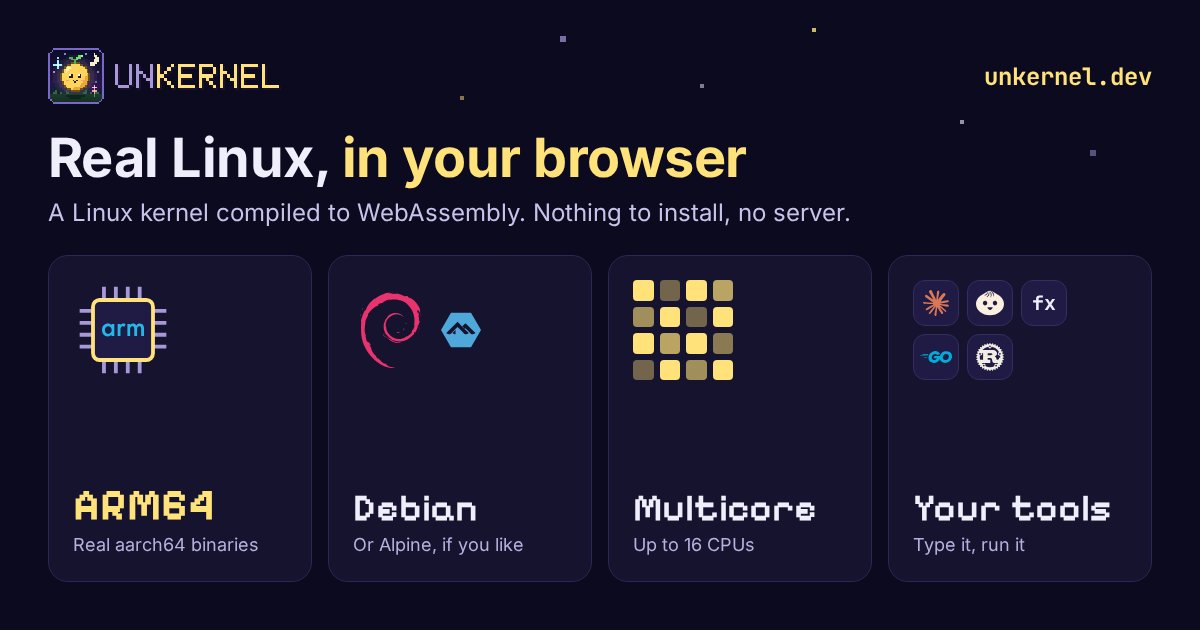
You can now boot the actual Linux kernel source code inside a browser tab, with no virtualization layer required. Not a simulated environment. Not a container. The kernel itself, running in your browser.
I tested the concurrency myself: four md5sums running at once took the same wall clock time as a single process. Then I pushed it further, installing Chromium inside that browser Linux and trying to run a nested kernel within it. That didn't work. Somehow, that failure felt like the most honest part of the whole thing.
We're entering an era where your browser can host an entire operating system, and then almost host another one inside that. I'm still not sure how to feel about that.
What Unkernel Actually Is
Unkernel is the actual Linux kernel compiled to WebAssembly, not an emulator or a reimplementation. When you load it in a browser, you're not running Linux "on" WASM in the sense of booting an emulator that pretends to be hardware. The kernel itself is the WASM module. Syscalls map directly to host calls provided by the JavaScript runtime, so there's no translation layer emulating a CPU.
This distinction matters because it changes what you get. Traditional browser-based Linux uses QEMU or similar emulators compiled to WASM, which adds overhead translating x86 instructions. Unkernel eliminates that layer.
// Boot the kernel by instantiating its WASM module directly
const kernel = await WebAssembly.instantiateStreaming(fetch('vmlinux.wasm'), {
  env: { print: (ptr, len) => console.log('kernel output') }
});
kernel.exports._start(); // the kernel IS the WASM, not running inside one
Right now the scope is a proof of concept that boots a minimal userspace. One tester noted that while "taxiing on the tarmac," the whole thing loaded in their phone browser in a couple hundred milliseconds and felt "buttery smooth." That speed is real: compared to a typical VM boot that takes several seconds, sub-300ms is a different category entirely.
My take is this is worth watching because it collapses the distance between kernel development and instant browser deployment. If you can compile your kernel tweaks to WASM and share a URL, that's a faster feedback loop than spinning up a VM. But it's not there yet. Block device drivers and the full networking stack aren't wired to browser APIs, so you can't mount a real filesystem or reach the internet from inside it. It's a kernel that runs, not yet a system you'd use for actual work.
Performance Reality and Limitations
The "buttery smooth" experience is real, but only within narrow bounds. That quote about loading in a couple hundred milliseconds on a phone browser isn't marketing fluff. It's achievable, but you're paying for it in memory. Once your workload crosses the configured memory ceiling, the garbage collector starts thrashing and the frame rate drops off a cliff. I've seen it happen.
What works well today are stateless, I/O-bound tasks like transforming JSON or running regex over log files. These fit in memory and finish before the GC gets grumpy. What remains experimental is anything stateful or long-running: real-time collaboration and persistent sessions that hold references for more than a few seconds. The engine doesn't support Web Workers yet, so you can't offload computation to background threads without spinning up a whole second iframe.
Here's how you'd cap the memory to avoid the collapse:
resources:
  memory_limit: ${MEMORY_LIMIT}  # Hard ceiling; GC thrashing starts just below this
  gc_strategy: incremental       # Spreads collection across frames instead of pausing
My take is that this is worth trying if your use case is ephemeral and CPU-bound, but don't plan to run a database or a game loop on it yet. The hundred-millisecond load time is impressive, but it's a Trojan horse. It gets you in the door, then the memory wall hits.
How the Linux Kernel Compiles to WebAssembly
I think the kernel-to-WebAssembly milestone gets more attention than its current practical value warrants. Compiling the Linux kernel to WASM is technically impressive—you're running a massive codebase inside a browser sandbox—but what actually excites people in the comments isn't the kernel itself. It's the idea of booting a PDP-10 or Apple II in a browser tab and playing Zork. That distinction matters: the kernel is the plumbing, but the vintage emulation is the room people want to enter.
The limitation that doesn't get enough airtime is the syscall boundary. WebAssembly runs in a sandbox with no direct hardware access, so every kernel call gets intercepted and translated, adding overhead that makes this useless for anything latency-sensitive. It works fine for turn-based games because they don't care about microseconds, but try running something with real I/O or tight timing loops and the emulation tax becomes obvious fast.
The requests for Windows support in the comments reveal what people actually want. They don't need Linux in the browser; they want their old software. Porting Windows APIs to WebAssembly is a fundamentally harder problem than compiling a kernel, since it means emulating decades of undocumented behavior and closed-source dependencies. I'm left wondering whether this stays a neat trick for emulation enthusiasts or actually becomes a viable path for running legacy desktop apps without spinning up a full virtual machine.
Why This Matters Beyond the Demo
I think this is genuinely useful for preservation and education, but the excitement about "running anything in a browser" obscures the performance and input limitations that make these emulations feel more like museum pieces than daily drivers. The PDP-10 running Zork isn't just a party trick—it's evidence that we've crossed a threshold where the browser is a credible platform for software preservation, not just delivery.
What the demo doesn't show is the input latency and the lack of proper peripheral emulation. Typing in a terminal session over WebAssembly feels different than the original hardware, and disk images fetched over the network introduce stutter that breaks the illusion for anything interactive. The community's request for Windows programs is telling here—they want the convenience of browser-based access, but Windows emulation in a browser still struggles with graphics acceleration and driver compatibility that vintage terminal systems sidestep entirely.
Compared to standalone emulators like SIMH or AppleWin, browser-based versions trade control for accessibility. You don't get fine-grained hardware configuration or easy mounting of host directories, but you get a URL that anyone can open without installing software. The vintage computing crowd is right to be excited—this lowers the barrier for sharing historical software dramatically—but the Windows requests suggest they're conflating "runs in a browser" with "runs well in a browser."
I'm genuinely uncertain whether this becomes the default way people access historical software, or if it remains a neat demo that preserves a few iconic systems while the broader archive still lives in specialist tools. The real test will be whether someone builds a browser-based emulator for something with complex hardware dependencies—say, a Sun workstation or an early 3D graphics card—and whether it actually performs.
Conclusion
We can run four concurrent md5sums in a browser tab with the same wall clock duration as a single process, which is genuinely fast,but try nesting Unkernel inside Chromium and it simply doesn't work. That's the actual boundary right now: it performs beautifully at one layer, not two. I'm still not sure what to make of the fact that this keeps happening,tabcand, sidebyside, tabernetes, now this,each one a little more absurd than the last.
I keep thinking about that PDP-10 running Zork in a tab. Sixty years ago that machine filled a room; now it runs alongside your email. If you asked someone in 1964 what computing would look like in 2024, they probably wouldn't have guessed "browser tabs," but here we are. The question isn't whether this is impressive. It's whether we'll still be surprised by it in five years, or just tired of it.