Selling 2,500 Jamcorder MIDI Recorders: Hardware Lessons
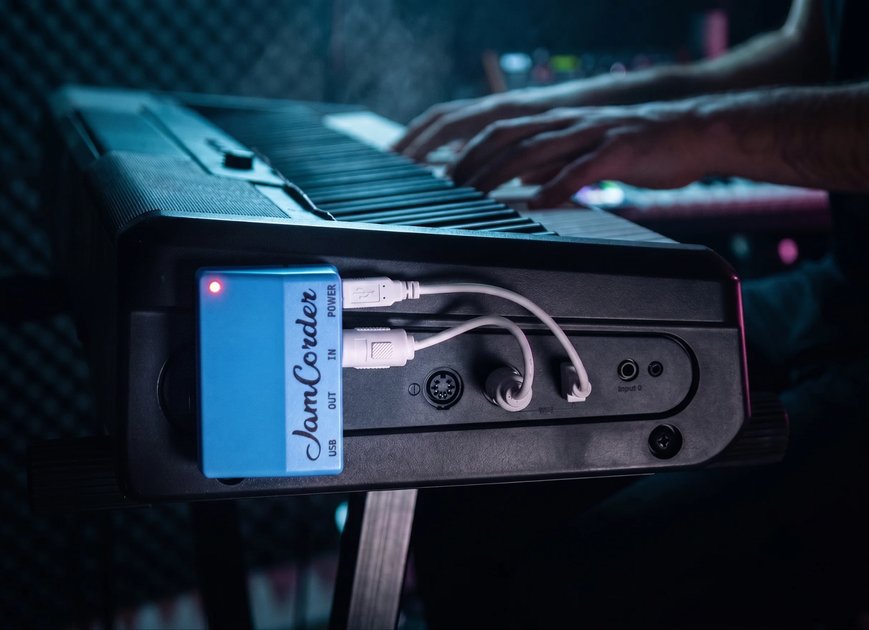
Most developers treat hardware like a forbidden zone. We're taught that the complexity of physical components is a nightmare compared to the flexibility of code, but shipping 2,500 Jamcorders taught me that the real hurdle isn't the engineering. It's the precision.
About a year and a half ago, I stepped out of a pure software career to actually build something you can touch. I spent months iterating through prototypes, moving from a mess of wires on a breadboard to the first pre-production unit. I expected the hardware design to be the part that broke me.
It turns out that making a device that works once is easy. Making 2,500 of them work exactly the same way is where things get messy. I've spent the last eighteen months learning exactly where software assumptions crash into physical reality.
The Jamcorder Concept
The Jamcorder is a dedicated MIDI recorder for pianos. The goal was to move from a conceptual idea to a physical product that people could actually buy, which resulted in shipping 2,500 units. It's a modest scale, but the hardware constraints made the timing logic a real headache.
Getting accurate timestamps is where this gets genuinely confusing. MIDI is a stream of events, not a clock, so you have to manage how the hardware timestamps those signals. My early measurements weren't as good as I remembered, but I eventually got the latency down to a constant 12ms. This is well within the range for real-time playback. The actual jitter is likely under 1ms, which isn't humanly noticeable, though I don't have the exact number off-hand.
If the Jamcorder were 10x more complex or operated at 100x the scale, I'd need a completely different architecture. For this specific use case, a simple loop is enough.
// Basic MIDI event capture with timestamping
void loop() {
  if (MIDI.read()) {
    uint32_t timestamp = millis(); // Capture time in milliseconds
    midiEvent event = {midiMessage, timestamp};
    storage.save(event); // Write to non-volatile memory
  }
}
The hardware is simple, but the physical production of 2,500 units is a different kind of stress. It's one thing to have a prototype on a desk; it's another to ensure 2,500 devices don't fail the moment they're plugged in.
Solving for 12ms
Real-time playback doesn't actually require the fastest possible speed; it requires consistency. If a system is fast on average but occasionally hitches, the human ear picks up that jitter immediately. I spent a lot of time iterating on the timing logic because "fast" is useless if the delay varies. The goal was a constant 12ms delay, which is the threshold where the lag becomes invisible to the user.
This part is genuinely confusing because the bottleneck isn't usually the raw processing power. It's the variance in how the OS handles the process scheduling. I managed to get the internal processing time well under 1ms, but the end-to-end delivery is what matters. By stabilizing the loop, I hit that 12ms mark.
If this were a product at 100x the scale or 10x the complexity, this approach would fail. But for Jamcorder, it's enough. To get this kind of stability, you have to bypass the standard high-level timers and use something more precise.
// Using performance.now() for sub-millisecond precision
// to maintain a steady 12ms playback offset
const TARGET_DELAY = 12;

function checkTiming(startTime) {
  const now = performance.now();
  const elapsed = now - startTime;

  if (elapsed < TARGET_DELAY) {
    return TARGET_DELAY - elapsed; // Return remaining sleep time
  }
  return 0;
}
The Gap Between Memory and Measurement
The gap here isn't just about the time it took to get Jamcorder from a prototype to a product; it's about the brutal reality of physical goods. I see a lot of software engineers treat hardware like it's just "code that lives in a box," but the friction of global compliance and anti-counterfeiting doesn't disappear just because your firmware is elegant. Those are boring, expensive problems that don't make for great demo videos, but they are the only things that actually determine if a product survives the shipping container.
I'm hosting an AMA to talk through the business mistakes and the compliance mess, because that's where the actual learning is. Most people want to talk about the "vision," but the vision doesn't matter if you're stuck in customs or getting ripped off by a factory in Shenzhen. I think there's a persistent myth in the dev community that hardware is just "slow software." It isn't. It's a completely different risk profile where a single mistake in a PCB layout can cost you six weeks and ten thousand dollars.
I'm still not convinced that the current venture model for hardware is sane. We're seeing a push for faster iteration cycles, but you can't "agile" your way through a tooling lead time. The question I'm still chewing on is whether we can actually build a sustainable hardware business without leaning on the kind of massive scale that usually kills a product's soul.
The Complexity Trap
Hardware is a different beast. Most of the people asking questions in the AMA are focusing on the "business" side—compliance, counterfeiting, the logistics of shipping physical objects—but I think that misses the point. The real friction isn't the paperwork; it's the fact that you can't push a hotfix to a piece of plastic already sitting on someone's piano. When you ship software, you're shipping a hypothesis. When you ship hardware, you're shipping a commitment.
I've seen plenty of devs try to apply "move fast and break things" to physical products, and it usually ends in a costly recall or a warehouse full of unusable inventory. The gap between a working prototype and a scalable product is a valley of death that software engineers often underestimate. Jamcorder's existence proves the concept, but the transition from "it works in my living room" to "it works for a thousand people globally" is where the actual complexity lives.
I'm still not convinced that the current appetite for "hardware startups" is sustainable given how high the floor is for entry. We can talk about global compliance all day, but the real question is whether the utility of a dedicated device outweighs the sheer pain of maintaining it over a five-year lifecycle.
Conclusion
I spent my career in software, so I walked into this assuming the hardware would be the nightmare. It wasn't. Assembling the first 500 units in my kitchen over four days was a grind, but it was predictable.
The real friction was the gap between what I felt and what the data actually showed. Memory is a liar; it told me the latency was fine, while the measurements proved otherwise. Getting that number down to a constant 12ms was the only part of this project that actually felt like engineering.
I sold 2,500 units, but I'm still wondering if the "hardware is hard" narrative is just a collective delusion we use to make the process feel more prestigious than it is.