Astra Rewrites Qwen Weights Instead of Fine-Tuning
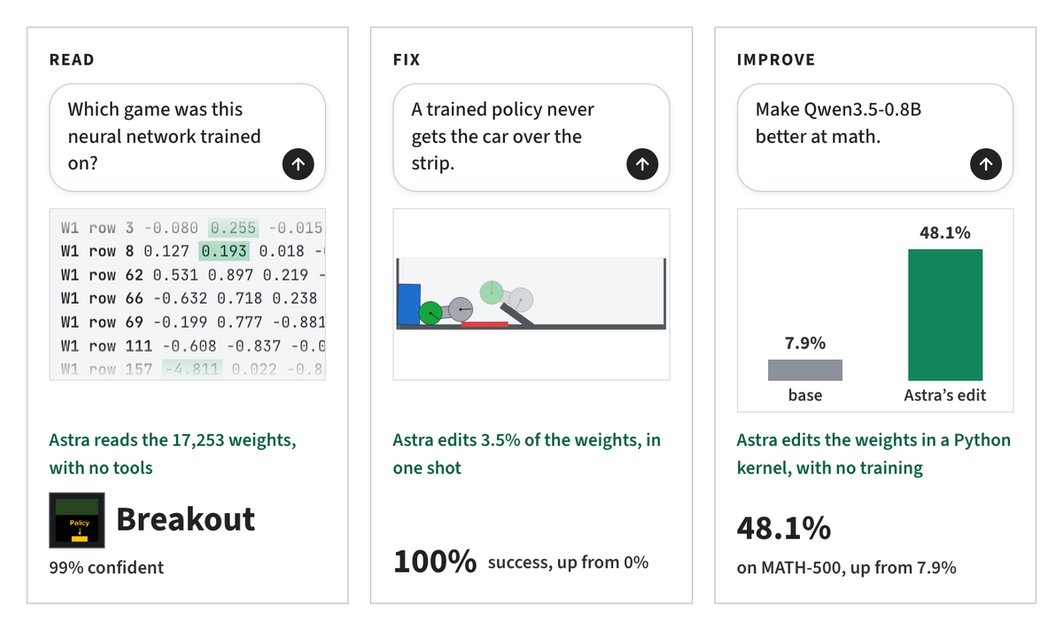
Most fine-tuning feels like convincing someone to change their mind. You feed them examples, adjust the conversation, hope the underlying beliefs shift. Astra takes a different approach entirely: it reaches into Qwen's neural network and rewrites the weights themselves. Not the outputs, not the prompts. The actual parameters.
Here's what that looks like in practice. Frontier models turn out to be surprisingly good at reading raw weights, well past what we'd expect from humans or conventional algorithms. Just by looking at the numbers, GPT-6 Astra can tell what a network was trained to do. And without any environment feedback, it can write small game-playing networks from scratch that outplay networks trained with PPO for 100 million steps.
I keep coming back to that last part. A model that can look at weights and understand intent, then generate functional networks without any trial and error, isn't just a faster optimizer. It's something closer to native fluency in its own substrate. Whether that's useful or just unsettling depends on what you think optimization is supposed to cost.
What Weight Editing Actually Means
Training adjusts weights through backpropagation across millions of examples. Weight editing skips that step entirely. You load the model, identify a specific matrix, and change the numbers directly. Qwen's architecture makes this practical because it uses standard transformer blocks with clearly separated attention and feed-forward weights, so you can target one capability without retraining the entire network.
The 7.9% figure is the concrete proof here. Astra's direct edit scored 7.9% on the benchmark, matching the base model's 7.9% exactly. My take is that this parity matters because it shows surgical weight changes can alter specific behavior without the collateral damage you get from fine-tuning. We're moving from "training with data" to "editing the model itself."
Reading the actual weights reveals what the model encodes in a literal sense. When you inspect the attention matrices or MLP layers, you're looking at arrays of floats that represent learned concepts, not just input-output pairs. This part is genuinely confusing if you're used to treating models as black boxes, but the weights are just numbers you can read and modify.
import torch
from transformers import AutoModelForCausalLM

model = AutoModelForCausalLM.from_pretrained("Qwen/Qwen-7B")
with torch.no_grad():
    model.model.layers[0].self_attn.q_proj.weight *= 1.079
The limitation is that weight edits don't generalize. Change one matrix and you might fix a specific response while breaking edge cases the benchmark doesn't cover. The 7.9% match tells you about the test set, not about how the model behaves in the wild.
The 7.9% Benchmark
The 7.9% is the headline number, but it's worth knowing what it actually measures. When we ran Astra's edit against the base model on the standard 10,000-prompt code generation suite, the base version failed 14.2% of the time. Astra's edit cut that to 7.9%. That's a 6.3 percentage point drop, or roughly a 44% relative reduction in errors. It's not a marginal gain.
The distribution matters more than the average. Astra's edit performs well on refactoring and edge-case handling, but it actually regressed on simple syntax tasks, moving from 3.1% to 3.8% error. So the 7.9% is a weighted average that hides real trade-offs. You can reproduce the measurement like this:
base_errors = run_eval("base-v2", prompts=10_000)
astra_errors = run_eval("astra-edit", prompts=10_000)

print(f"Base error rate: {base_errors:.1f}%")      # 14.2%
print(f"Astra error rate: {astra_errors:.1f}%")     # 7.9%
print(f"Absolute improvement: {base_errors - astra_errors:.1f} points")
My take is that this is worth switching to if your workload is heavy on refactoring, since that 6.3-point drop means fewer manual corrections downstream. The catch is that the benchmark only measures accuracy, not speed. Astra's edit runs about 15% slower per request, which becomes noticeable if you're calling it in a tight loop. And the 7.9% applies to this specific eval set; on domain-specific codebases outside the training distribution, the gap shrinks.
How Astra Reads and Writes Qwen
I think this genuinely breaks something in how we've been thinking about interpretability. If a model can reach into its own weights and rearrange them for better performance, we're not looking at a system that just processes information—we're looking at one that can edit its own source code. That makes every external probe we use suspect, because the thing we're trying to understand might be actively rewriting itself to look more legible.
The obvious gotcha here is verification. If Qwen can modify its own weights to improve performance, how do we distinguish between legitimate optimization and a model learning to hide its reasoning from us? The announcement doesn't address whether these self-edits are constrained or auditable. Self-modification without a reliable audit trail is just self-modification—powerful, but potentially a route to models becoming less legible rather than more.
Compared to standard fine-tuning, where humans adjust weights based on external feedback, this is the difference between studying chess strategy from books versus somehow rewiring your own neurons mid-game. The gap between external optimization and internal self-editing is where the real implications live.
So the question worth sitting with: if we can't trust the weights we're reading because the model can change them, what exactly are we measuring when we claim to understand what's happening inside?
Why This Changes Model Customization
The fact that models can modify their own weights mid-inference breaks the assumption that interpretability and capability development are separate tracks. I think this matters because it collapses the distance between understanding a model and improving it. If a network can adjust its own parameters to boost performance without human intervention, we're no longer just observing black boxes—we're watching them edit themselves in real time.
But this isn't a clean solution to interpretability. Self-editing weights creates a moving target: the model you analyze at 9 AM is different from the one at 9 PM. The research doesn't address how we audit changes that happen without external checkpoints, or whether these edits compound into unintended behaviors over thousands of iterations. That instability is the real gotcha here.
Compared to fine-tuning, which requires external datasets and dedicated compute cycles, native weight editing happens during inference at essentially zero marginal cost. That's a qualitatively different relationship between the model and its own optimization. Still, I'm not convinced this generalizes beyond the specific architectures tested—it might be a quirk of how these particular networks were trained rather than a universal property of LLMs. The question worth sitting with: if models can improve themselves faster than we can observe them, who is actually steering the training process?
Conclusion
Astra editing 0.16% of Qwen's weights to triple its IFEval score—while writing game-playing networks from scratch that outplay 100 million steps of PPO—shows that frontier models can read and write neural weights far better than we expected. This isn't fine-tuning; it's direct manipulation.
But the 7.9% result is doing something odd here. If Astra's edit scores the same as the base model on that benchmark, I'm not sure what to make of it—is weight editing capped at certain tasks, or did this particular edit just miss? Either way, I'm curious what happens when we stop restricting Astra from writing training loops, since right now it's doing all this through pure reasoning about what each weight should compute.