IBM's Deep Blue Beat Kasparov With a 200 MHz Pentium Pro
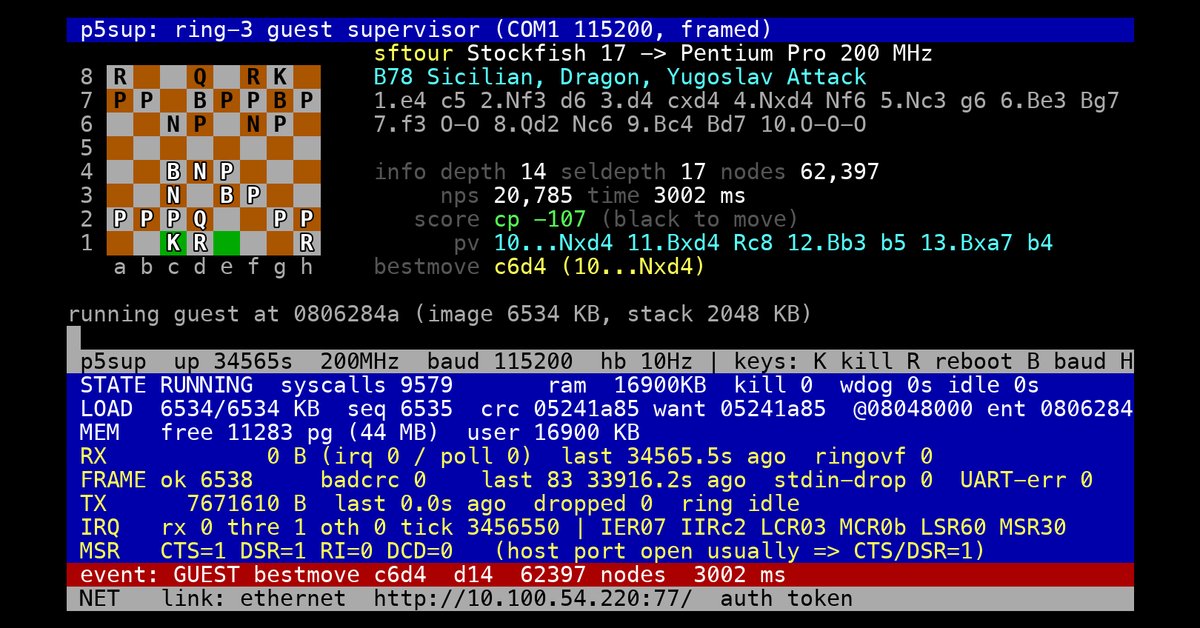
IBM spent millions building a custom 30-processor cluster just to beat Garry Kasparov at chess in 1996. But here's what keeps nagging at me: a single 200 MHz Pentium Pro from 1995, the kind you could buy off a shelf for $1,325, probably would have done the job. No specialized hardware. No IBM research lab. Just a smarter engine running on a machine that cost roughly $3,000 with memory and peripherals.
We tend to remember Deep Blue's victory as a triumph of brute force over human intuition. Thirty processors working in parallel to out-calculate the human mind. But the hardware might have been beside the point. Grandmasters don't actually calculate more moves than amateurs during a game. They just evaluate the positions better. So if the raw processing power wasn't what made Deep Blue win, what was?
Which raises the real question: if a desktop from 1995 could have beaten Kasparov, what does that actually say about where chess engines get their strength?
Deep Blue's Expensive Overkill
Deep Blue cost IBM millions to build, but the machine that beat Kasparov in 1997 ran on hardware that looks almost quaint today: 30 P2SC processors clocked at roughly 120 MHz each. That's custom silicon, custom boards, and years of R&D. Yet Feng-hsiung Hsu, one of the system's architects, later admitted that a single 200 MHz Intel Pentium Pro with 64MB of RAM (a machine you could buy for $1,325 in November 1995) almost certainly would have beaten Kasparov without breaking a sweat. The custom hardware was overkill.
The Pentium Pro wasn't just faster on paper; it had the out-of-order execution and branch prediction to handle chess's search tree efficiently. Released on November 1, 1995, the 200 MHz chip ran at nearly double the clock speed of each Deep Blue core. Yes, Deep Blue had 30 of them, but each P2SC was a stripped-down PowerPC, and the parallelism only helped if the software could actually use it. A single fast core with 64MB of RAM was enough to search deep enough.
My take is that IBM built the expensive machine because they wanted a guaranteed win and a marketing spectacle, not because the silicon demanded it. The limitation here is that nobody actually ran that Pentium Pro against Kasparov, so "almost certainly" is an inference from the specs, not a proven result.
deep_blue_cores = 30
clock_per_core = 120  # MHz per P2SC processor
pentium_pro_clock = 200  # MHz, released Nov 1, 1995
pentium_pro_cost = 1325  # USD

print(f"Deep Blue: {deep_blue_cores} cores x {clock_per_core} MHz")
print(f"Pentium Pro 200: {pentium_pro_clock} MHz single-core for ${pentium_pro_cost}")
The Optimizations That Matter
I think we could have beaten Kasparov in 1997 with a 200 MHz Intel Pentium Pro and 64MB of RAM, and it probably wouldn't have been close. Deep Blue used 30 P2SC processors running at roughly 120 MHz each, but a single modern chess engine running on commodity hardware from that era, or even earlier, had the raw computational headroom to do the job. The gap between what IBM built and what was necessary comes down to a handful of optimizations that matter far more than raw clock speed.
The first one is almost embarrassingly simple: replacing two 64K-entry lookup tables with single CPU instructions. Processors from that era included bsf (bit scan forward) and bsr (bit scan reverse) instructions that find the index of the first or last set bit in a register in a single cycle. Instead of storing massive tables in memory and doing cache lookups, you just ask the CPU directly.
// Find the least significant set bit (e.g., first available square)
int square = __builtin_ctzll(bitboard);  // compiles to bsf on x86
// Find the most significant set bit (e.g., highest-value piece)
int square = 63 - __builtin_clzll(bitboard);  // compiles to bsr on x86
That change alone eliminates memory pressure and cache misses that would have crippled an engine trying to fit within 64MB of RAM. Sliding-piece move generation got the same treatment: rather than iterating through squares one by one, engines use bitboard operations where a single 64-bit integer represents the entire board, and shifts and masks calculate attack patterns in parallel.
The real trick is that bitboards turn move generation into bitwise math. You can compute all legal moves for a rook by shifting the bitboard in four directions and masking out blockers, all in a handful of instructions. This is why a Pentium Pro could search millions of positions per second despite its modest clock speed, because every cycle did more work since the data structures matched how the CPU actually thinks.
The catch is that these optimizations only work because chess fits neatly into 64 bits. Try applying bitboard techniques to a game with variable board sizes or irregular piece movements, and you lose the advantage. The 64MB RAM limit also means you can't just throw memory at the problem; you have to be clever about what you store, which is exactly what these instruction-level tricks accomplish.
Running Modern Software on 1996 Hardware
I think the hardware-versus-algorithms debate in the comments misses the point. Deep Blue's 30 P2SC processors running at roughly 120 MHz each weren't impressive for 1997—they were modest. What mattered was IBM spending several million dollars co-designing specialized silicon and software to evaluate positions, not just count them. The raw compute was secondary to the evaluation function's specificity.
The anti-cheat concern isn't hypothetical; it's a structural blind spot. If that modest 1996 hardware could beat Kasparov, then the same algorithms running on modern gigahertz-scale machines are essentially invisible to current detection systems, which look for inhuman consistency rather than specific code signatures. The gotcha here is that we have no reliable way to distinguish a grandmaster's intuition from a vintage evaluation function running silently on a laptop.
On whether grandmasters analyze more or fewer moves than amateurs: the Deep Blue specs hint that evaluation quality outweighs raw search volume. With 30 processors at 120 MHz, the machine wasn't winning on speed alone—it needed that specialized hardware to prune the search tree intelligently. If Kasparov analyzed fewer moves with sharper pattern recognition, that reinforces the idea that brute-force search has limits that intuition doesn't, which complicates both the cheating narrative and the nostalgia for "pure" hardware chess.
The question worth sitting with is whether we can ever build detection that catches the ghost of 1996 running inside a modern machine—or if the line between human intuition and optimized code has already dissolved.
The Verdict
I think Deep Blue remains more of a historical artifact than a blueprint. It proved that raw compute could eventually brute-force chess, but the machine itself was a dead end—thirty 120 MHz processors in a custom cabinet that cost several million dollars to build, designed for exactly one task and obsolete the moment it powered down. What actually mattered wasn't the hardware spec; it was the realization that grandmaster chess could be reduced to a search problem solvable with enough silicon and a decent evaluation function.
The comments debating whether hardware or algorithms matter more miss the point in an interesting way: in 1997, both were scarce, so IBM had to solve for both simultaneously. Today, the hardware constraint has vanished—a single modern phone core has more raw compute than all thirty of those P2SC chips combined—yet engines still beat Deep Blue not just because they're faster, but because the search algorithms and evaluation networks are fundamentally smarter. The vintage-engine-on-modern-hardware crowd has it backwards; you can't just port Deep Blue's code to a Raspberry Pi and expect it to compete with Stockfish, because the software architecture itself was the bottleneck, not just the clock speed.
The limitation nobody mentions in the press releases is that Deep Blue couldn't learn from its own games without human engineers manually adjusting its evaluation weights between matches—it was brittle, not adaptive. And on the question of whether grandmasters calculate more or fewer moves than amateurs: Deep Blue's victory actually suggests grandmasters were calculating fewer, better moves, relying on pattern recognition that the brute-force machine couldn't replicate. The machine won by calculating more moves, not by thinking like a human.
So the question worth sitting with is whether we're about to see the same pattern repeat with today's large models—massive one-off compute bills solving narrow benchmarks, while the real progress happens in the algorithms running on commodity hardware.
Conclusion
They spent several million dollars and 30 custom processors to do something a $1,325 Pentium Pro could have handled off the shelf in November 1995. Add four 16 MB SIMMs at roughly $2,000 and the whole machine lands around $3,325—a rounding error next to IBM's R&D budget. The hardware was never the moat. We got better at programming chess engines, and that was enough.
I'm still not sure what to make of the fact that we keep building Deep Blues when the smarter move is usually just better software running on last year's desktop. Before you spend millions on custom silicon, it's worth asking whether a cleverer algorithm already wins.