Postman Silently Shares API Data Through AI Plugins
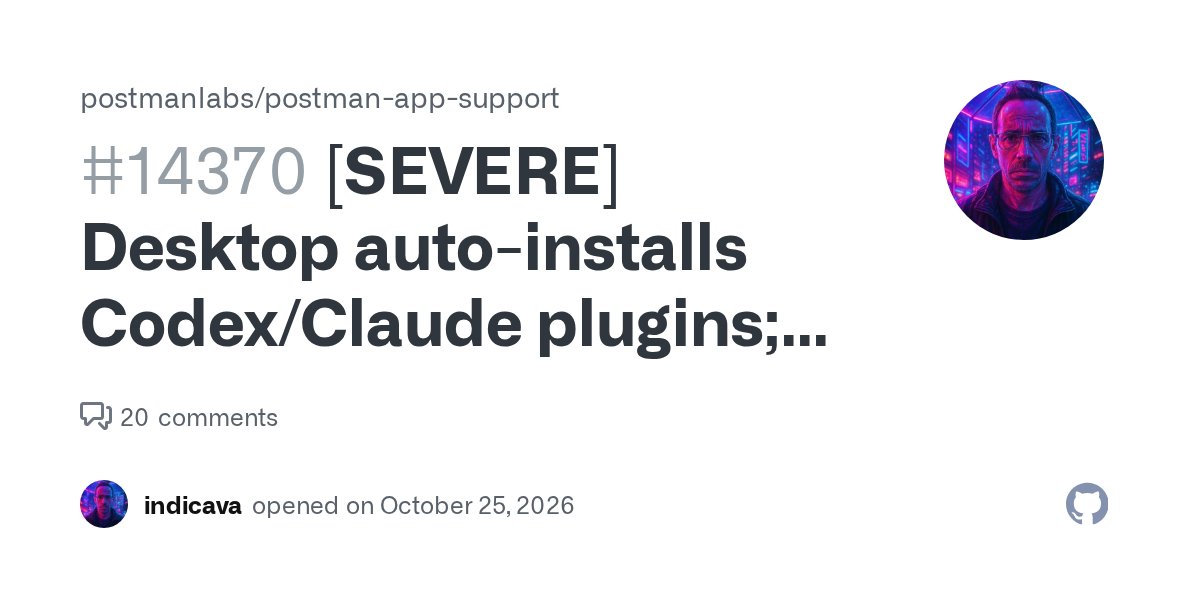
Postman just shipped an update that auto-installs Codex and Claude plugins into your desktop app without asking, then attempts to make itself a trusted startup item. I saw the security alert myself when I switched accounts in another window: issue #14370, flagged SEVERE, describing how the installer tries to trust its own startup hook. It's the kind of move that makes you wonder who's actually in control of your API workspace.
I've used Postman for years, and I generally like what the team is building. But silently installing AI plugins and routing your requests through third-party servers isn't a feature update. It's a quiet change in the terms of the relationship between you and the software running on your machine.
The UI shows the usual suspects: New issue, Copy link, Open, Description, Metadata. Nothing in that interface tells you your traffic is now potentially flowing through infrastructure you didn't choose. So what happens when you dismiss that alert, and is there any way to actually opt out?
The Silent Installation
Postman's auto-update mechanism now installs AI plugins without asking. When you launch the app after an update, background processes drop new plugin bundles into your local Postman directory and register them before the UI even renders. The installation triggers automatically during the standard update check that runs on startup, and there's no consent dialog, no toggle in settings, and no mention in the release notes.
find ~/Library/Application\ Support/Postman -name "*.plugin" -mtime -7 2>/dev/null || \
find ~/.config/Postman -name "*.plugin" -mtime -7 2>/dev/null
The setup flow makes opting out effectively impossible. When you do get a prompt, it's framed as a feature tour rather than an installation notice, and the skip option sits behind a secondary link. "Postman went from a great lightweight tool to a bloated up-selling mess," as one complaint put it. "Does everything have to go to shit when money is involved?" Both capture the shift from a utility that did one thing well to a platform pushing AI features you didn't request.
My take is that this crosses a line other API tools haven't: Insomnia and Bruno don't auto-deploy plugins during updates, and even heavy IDEs ask before installing extensions. The real gotcha is that deleting the plugin files doesn't stick. They reinstall on the next auto-update unless you disable updates entirely, which means missing security patches. That trade-off makes the feature hard to live with and harder to escape.
How to Audit and Lock Down Your Workspace
The audit comes first because Postman workspaces now default to cloud sync, which means your collections, environments, and API keys are already sitting on their servers unless you explicitly opted out. Start by listing every active integration connected to the workspace. These are the pipes that move data out, and you can't lock down what you haven't enumerated.
curl -s "https://api.getpostman.com/integrations?workspace=$WORKSPACE_ID" \
  -H "X-Api-Key: $POSTMAN_API_KEY" | jq -r '.integrations[].type'
With the list in hand, revoke access at the workspace level. Open Workspace Settings, go to Integrations, and manually disconnect anything you don't recognize. Watch for Slack, GitHub, and Jira hooks. They often carry broad scopes like chat:write or repo that let external services read or modify your workspace data.
To block future automatic installations, disable the auto-install toggle in Workspace Settings under Integrations. If you're on a paid plan, enforce this centrally through the Admin API so individual team members can't re-enable it per request. This stops Postman from silently adding new connectors when you install popular templates.
I think Postman's pivot from a local-first tool to a cloud-synced platform with constant upselling is a genuine regression, and treating these lockdown steps as mandatory hygiene is the only responsible way to use it now. One gotcha: these settings don't retroactively purge data already synced to Postman's servers. If your workspace has been cloud-enabled for months, the audit reveals exposure that already happened, not just risk you're preventing. Compared to Postman 7.x, where collections stayed on your machine by default and sync was opt-in, current workspaces assume the opposite.
What Data Actually Leaves Your Machine
The fact that Postman now requires sign-in for basic features isn't just an annoyance,it restructures where your API data lives. When you create a request locally, it syncs to Postman's servers by default, which means your internal endpoints, auth tokens, and environment variables are traversing a third-party network even when you're just testing against localhost. That's a meaningful shift from the tool's original promise of working entirely offline.
I think this explains a lot of the migration to Bruno and Insomnia. Those tools treat local storage as the default, not the premium tier. The frustration isn't just about bloat,it's that the bloat is designed to extract data while making you pay to keep it private. When a tool that used to be a desktop app starts behaving like a SaaS product, the trust erodes fast.
The limitation here is that Postman's collaboration features genuinely work well for distributed teams, so the data trade-off isn't purely negative,it buys you real functionality. But for solo developers or anyone handling sensitive internal APIs, the cost of that convenience is higher than it looks. The UI elements you're seeing,the "New issue" button, the metadata panel,signal that this is now a cloud-first product wearing a desktop app's clothes.
I'm not sure the pricing tiers will reverse the exodus. Once developers switch to a local-first workflow, they notice how much quieter the tool becomes. My question is whether Postman can offer a true offline mode without undermining the revenue model that now drives the product.
Why Forced AI Integration Threatens Developer Trust
I think Postman is mistaking feature addition for value creation. When you force AI into a workflow that was previously fast and predictable, you're not enhancing the tool—you're changing what it is. The UI elements surfacing now, like persistent "New issue" prompts and AI-flavored metadata fields, signal a shift from "tool that gets out of your way" to "platform that wants to be in your way."
The migration to Bruno and Insomnia isn't just grumbling; it's a measurable exodus from a tool that once had near-universal adoption in API testing. Bruno's pitch is almost explicitly a reaction to Postman's bloat—local-first, no account required, no AI features you didn't ask for. That developers are willing to switch to a newer, less mature tool tells you the trust damage is real, not theoretical.
What I'm uncertain about is whether Postman can reverse this. Making AI features opt-in would help, but only if they also strip back the commercial UI elements that made the tool feel heavy in the first place. If they treat this as a PR problem rather than a product philosophy problem, the migration will continue. Will developers forgive a tool that added friction to solve a problem they didn't have, or is this the moment Postman loses its default status in the API workflow?
Conclusion
Postman Desktop is installing Codex and Claude plugins on your behalf and asking your OS to trust its own startup hook, all triggered by nothing more than switching accounts in another tab. Issue #14370 isn't just a bug report—it's a [SEVERE] demonstration that "AI-powered workflows" can mean silent deployment of third-party code with access to your API data. I think this crosses a line most developers didn't realize existed.
The real cost isn't the plugins themselves; it's the precedent that a tool you use to manage secrets can modify your system's trust store without showing a dialog. Until installation becomes an explicit opt-in rather than a background assumption, the only safe workspace is one where you've manually audited every extension and disabled auto-updates for plugins.
Open Postman now and check your installed plugins—if Codex or Claude are there without your explicit consent, remove them. I'm still not sure whether "AI integration" in developer tools will ever mean anything other than expanded surface area for data to leave your machine quietly, and I suspect it won't.